EWED launches the Wildfire Data Portal for better preparedness and response
Wildfires

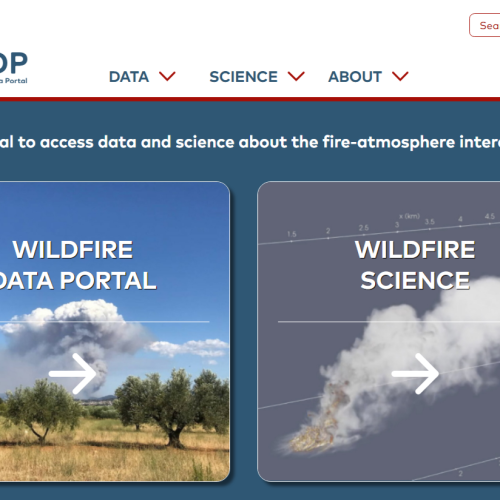
The EWED projectopens in new tab launched the Wildfire Data Portalopens in new tab (WDP), an open-access platform that brings together field data from wildfires and prescribed burns with science-based tools that explore fire–atmosphere interactions during Extreme Wildfire Events (EWEs). Co-developed by firefighters and meteorology researchers, it seeks to strengthen operational decision-making for safer and more effective preparedness and response to extreme wildfires.
The frequency and intensity of wildfires are rising worldwide due to global changes. EWEs are becoming increasingly common in traditional fire-prone areas such as southern Europe, while areas like northern Europe are more and more vulnerable. This evolving scenario calls for new approaches to preparedness and response—approaches grounded in empirical data and science. The WDP delivers exactly that.
The Wildfire Data Portal marks a major milestone for the EWED project. For the first time, firefighters, researchers and civil protection agencies can access a shared, science-based environment built directly from operational experience, empirical data and cutting-edge knowledge on Extreme Wildfire Events (EWEs). This collaboration is essential for strengthening preparedness and supporting operational decision-making in the face of increasingly frequent EWEs across Europe.
The portal has been designed by the project partners from both an operational and an academic perspective to meet the needs of both sectors. It compiles field data from prescribed burns and wildfires - including EWEs - collected by wildfire practitioners since 2021 in Spain, Greece, the Netherlands and Chile. The project’s scientific team uses these datasets to generate 3D wildfire simulations and computer models.
Each fire entry includes a description, photos and videos, fire behaviour and surface observations, hourly perimeters, and measurements of the vertical atmospheric profile (see exampleopens in new tab). The latter are taken with radiosondes, following a method optimised by the Catalan Fire and Rescue Service and described in ‘Protocols for data collection on Extreme Wildfire Events’ (available in Englishopens in new tab and Spanishopens in new tab). For the first time, firefighters have collected atmospheric measurements from inside fire plumes, providing unprecedented insight into EWE dynamics.
The data in this portal come directly from the field—from firefighters documenting conditions in real time and even launching radiosondes inside fire plumes. This effort reflects a commitment to learning from every fire. By transforming operational experience into shared knowledge, the Wildfire Data Portal helps firefighters better understand extreme fire dynamics and prepares us to protect people, ecosystems and communities more effectively.
The associated computer representations are CLASS models (Chemistry Land Atmosphere Soil Slab), which explore the weather conditions driving fires (see examplesopens in new tab). A new capability introduced within EWED enables users to estimate wildfire plume-rise height (see how hereopens in new tab). With regards to 3D plume simulationsopens in new tab, they allow comparison with observed plume development and support exploration of fire behaviour under different climate conditions (see how to set them up hereopens in new tab).
By combining field observations with CLASS modelling and 3D plume visualisations, the Wildfire Data Portal offers a new window into how the atmosphere and wildfire behaviour interact. These tools help us understand not just what happened during extreme events, but also why it happens. That knowledge is crucial for anticipating plume development, identifying risks, and improving the decision-making environment for those working on the fire line. Furthermore, the tools allow for explorations of scenarios for which no data is available, and therefore provide us a way to prepare for future wildfires.
An additional highlight of the portal is the EWED Knowledge clipsopens in new tab, developed by Wageningen University and Research and the Netherlands Institute of Public Safety. They are engaging short videos that explain key scientific concepts behind EWEs. Furthermore, users can access scientific publications and all other resources produced by the project.
With wildfires becoming increasingly complex, anticipating their behaviour requires a deeper understanding of fire–atmosphere interactions and turning that understanding into operational capability. With the Wildfire Data Portal, EWED brings forward a novel tool that unites data and science to support safer and more effective preparedness and response across Europe and beyond.
Sectors
