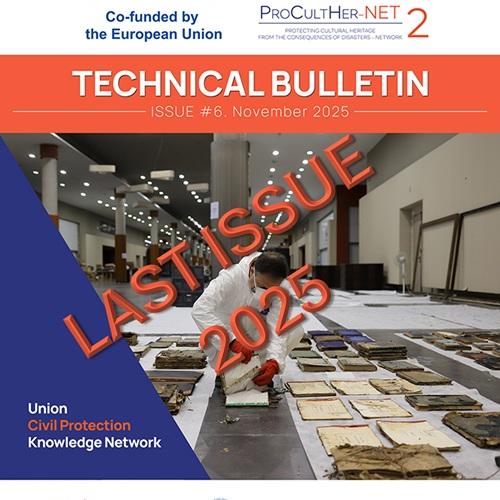
In the summer of 2025, the PROCULTHER-NET 2 project successfully delivered another edition of the Protecting Cultural Heritage course (PCH) to 64 trainees from 23 UCPM countries. During the training week in Caserta, Italy, we once again witnessed the high level of efficiency that can be achieved when cultural heritage and civil protection experts collaborate closely. This is precisely the objective that the Technical Bulletins have been striving to achieve for the past three years: to share practical experiences in the protection of cultural heritage in crises, to inform the thinking and practices of civil protection and cultural heritage experts alike.
This sixth issue of the Technical Bulletin opens with a foreword from the European External Action Service - EEAS, which reaffirms that the protection of cultural heritage transcends national and European borders, particularly in times of conflict. The two highly practical examples that open our FOCUS ON section demonstrate this perfectly. The first one exemplifies how a third-party international non-profit organisation, such as the ALIPH Foundation, can play a pivotal role in implementing on-the-ground measures for the emergency protection of cultural heritage during an armed conflict. The second article illustrates how the decades-long, unique experience of the Carabinieri Command for the Protection of Cultural Heritage - TPC has been deployed in post-conflict countries such as Kosovo and Iraq to combat illicit trafficking.
The PREVENTION section features a Polish article on basic prevention measures to safeguard historic wooden houses in rural areas likewise underlines the importance of protecting vernacular cultural heritage, which is often unlisted and in the care of private owners.
In the PREPAREDNESS section, we discover the role played by French grassroots organisations such as Blue Shield France and the French Association for Disaster Risk Prevention - AFPCNT in raising awareness of risks and promoting a culture of resilience among private owners of cultural heritage, alongside civil protection authorities.
In addition, this section highlights the initiatives taken by Croatia in the aftermath of the 2021 earthquake, which served as a wake-up call. In line with the recent articles on Romania (1) and Hungary (2), the first article discusses the steps taken by both civil protection and cultural heritage authorities to reassess their procedures, drawing on the experiences of other European countries. The second article is a contribution from the Croatian Civil Protection Directorate, which shares lessons learned from two training exercises designed to enhance preparedness and foster collaboration between civil protection and cultural heritage experts. Finally, the section closes with an article focusing on the efforts of the Tuscany and Marche regions of Italy to develop specialised civil protection mobile units with specific equipment for use in heritage protection during emergencies.
The RESPONSE section takes us to Belgium to explore the lessons learned from the devastating floods of 2021. The KIK-IRPA article analyses the gaps identified in response processes and elaborates on the measures that have been implemented in recent years to address them and enhance the response capacities.
Finally, in the RECOVERY section, we are pleased to present to you the second part of the Valencian Institute of Conservation, Restoration and Research - ICVR+i article on the 2024 floods in the Valence community (3), which focuses on stabilising the documentary heritage and future measures. This valuable testimony is one of the first contributions on this subject to be shared at the European level, and we hope it will help experts in other countries to prevent, plan for, prepare for, respond to, and recover from disasters affecting cultural heritage more effectively.
We thank all the authors and reviewers who have made the publication of this sixth issue possible and wish you all an inspiring dive into this new collection of articles.
Download the previous issues
(1) Pop A., Key steps to protect cultural heritage. Elements of specific legislation in Romania, in PROCULTHER-NET Project. Technical Bulletin N. 5, July 2025. pp. 76-82. ISSN2975-190X- ISBN 978-88-6864-548-9
(2) Lt. Col. Domján G., Experiences in capacity building of cultural heritage rescue in Pécs, Hungary, in PROCULTHER-NET Project. Technical Bulletin N. 5, July 2025. pp. 83-90. ISSN2975-190X- ISBN 978-88-6864-548-9
(3) Chuliá Blanco, I. et al., Rescue of Movable assets and Damage Assessment after the 2024 Floods in the Valencian Community – part 1, in PROCULTHER-NET Project. Technical Bulletin N. 5, July 2025. pp. 42-53. ISSN2975-190X-ISBN 978-88-6864-548-9