Advancing integrated wildfire risk management in Iceland
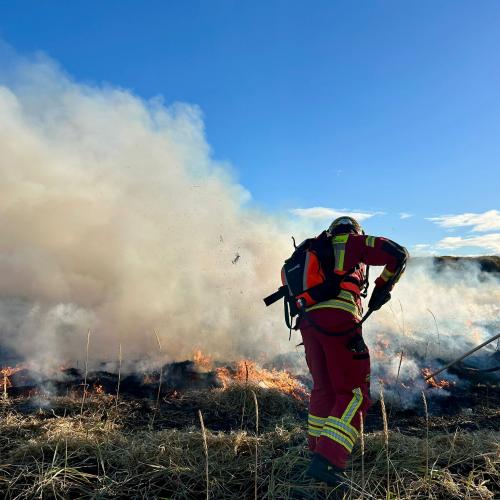
Wildfire risk in Iceland is rising. This risk is linked to climate change, evolving land use patterns and expanding vegetation.
Wildfire risk in Iceland is rising. This risk is linked to climate change, evolving land use patterns and expanding vegetation.
Afforestation areas, recreational zones and areas near vegetation are particularly vulnerable. For example, in 2021, a wildfire in the Heiðmörk conservation area near Reykjavík – critical for the capital's water supply – burned 56.5 hectares, prompting authorities to issue Iceland's first-ever wildfire danger alert. In 2023-2024, moss fields in the Grindavík area caught fire, triggered by volcanic activity on the Reykjanes Peninsula.
According to the Technical Assistance Financing Facility for Disaster Prevention and Preparedness (TAFF) report, there is an urgent need to strengthen Iceland's capacity across the entire wildfire risk management spectrum. Between 2024 and 2025, a Union Civil Protection Mechanism grant from the TAFF supported Iceland’s Department of Civil Protection and Emergency Management in assessing the current status, key challenges and opportunities to improve wildfire risk management. Financed by the grant, a team of experts from the World Bank Group, Prepared International, and the European Forestry Institute / FoRISK team, working with Icelandic counterparts, conducted a diagnostic review and two rounds of in-country stakeholder consultations.
This work produced a set of recommendations to improve governance and planning, risk analysis and communication, wildfire prevention, and preparedness and response. Summarised in a technical reportopens in new tab and briefopens in new tab, the recommendations aim to strengthen Iceland’s integrated wildfire risk management, improve institutional coordination, and build national resilience to this emerging threat. Immediate next steps include setting up a working group with the Icelandic Fire Captains.

This project helped us to raise awareness of this risk and re-ignite stakeholders’ commitment to act on it. The activities conducted equipped us with knowledge, new ideas, as well as new connections relevant for wildfire risk management and emergency preparedness in general. We already see positive impact and are taking on some of the recommendations.
Beyond sharing good practice from different countries, this project also helped to strengthen national preparedness and response capacities. This was achieved by facilitating the participation of several fire chiefs at the Fire Camp in Poland in May 2025, and by bringing experts from the European Forestry Institute / FoRISK team together to deliver technical training in Iceland in October 2025. Additional information, including videos, is available on the FoRISK websiteopens in new tab. The findings were shared with stakeholders in Iceland and presented at a TAFF workshopopens in new tab in Belgium in October 2025. The full set of reports produced under TAFF is available on the Global Facility for Disaster Reduction and Recovery (GFDRR) websiteopens in new tab.
| The Technical Assistance Financing Facility for Disaster Prevention and Preparedness (TAFF) is a 100% EU-financed initiative, implemented as a partnership between the European Commission through its Directorate-General for Civil Protection and Humanitarian Aid Operations (DG ECHO), the World Bank, and the Global Facility for Disaster Reduction and Recovery (GFDRR). |