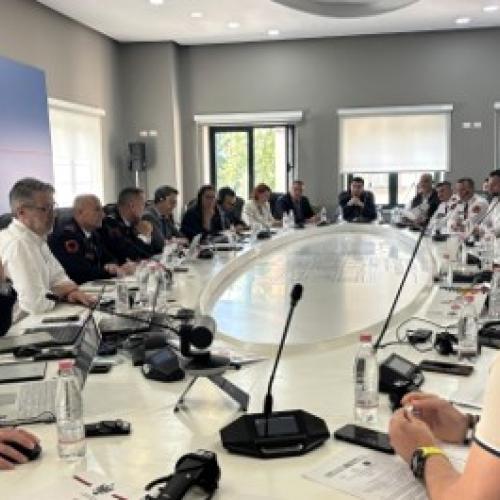
The workshop marked the conclusion of the Strengthening Albania's Fire Risk Management (FRISC) project, implemented by the World Bank in partnership with the Ministry of Interior and the General Directorate of the Fire Protection and Rescue Service, with financing from the European Union through the Technical Assistance Financing Facility for Disaster Prevention and Preparedness (TAFF). Discussions focused on how the project's outputs—including a modernisation roadmap, risk-informed capacity planning methodology, guidance on stations, vehicles and equipment, wildfire preparedness analysis, and an investment prioritisation framework—can support the modernisation of Albania's fire protection and rescue system and strengthen coordination within the broader civil protection framework.
Opening the workshop, Mr Arben Cara, Director General of the Fire Protection and Rescue Service of Albania, underlined the urgency of modernising the sector. “Our fire and rescue service must be better organised, more standardised, and more capable of responding quickly and in a coordinated manner,” he said, noting that the FRISC project provides a strong foundation for capacity planning, standardisation, and future risk-based investments.
A central theme of the workshop was the need to move beyond traditional population-based approaches to planning fire and rescue capacities. The FRISC methodology complements population-based criteria with hazard exposure, geography, response times, industrial and transport risks, wildfire exposure, water availability, and existing operational capacities. Pilot applications demonstrated that municipalities with similar populations may require very different levels of resources depending on their risk profiles. Participants also discussed how standardised guidance for stations, vehicles, equipment, and operational modules can support more coherent procurement, training, maintenance, interoperability, and mutual support across municipalities.
Wildfire preparedness featured prominently throughout the discussions. Albania is facing increasingly severe wildfire seasons, exposing gaps in prevention, preparedness, response coordination, training, and equipment. The project identified opportunities to strengthen Incident Command System implementation, improve air-ground coordination, enhance early warning capabilities, and expand specialised wildfire training and operational capacities.
The workshop also highlighted the scale of investment required to modernise Albania's fire protection and rescue system. Intervention capacity modelling estimated indicative investment needs of approximately EUR 355 million over the next eight to ten years for station infrastructure, vehicles, equipment, training, and support systems. While intended as a strategic planning estimate rather than an investment plan, the analysis provides a valuable basis for prioritising investments and sequencing future financing.
A common message throughout the event was that strengthening fire and rescue services requires more than new vehicles and equipment. Building a resilient system depends on strong institutions, clear standards, risk-informed planning, effective coordination, and sustained commitment at both national and local levels.
Looking ahead, Mr Cara emphasised the importance of turning the project's recommendations into concrete action. “Our common goal is clear: greater safety for citizens, better-prepared institutions, and a more modern, professional and reliable fire protection and rescue service.”
As Albania continues to strengthen its disaster preparedness and response capacities, the FRISC project has provided a shared technical foundation for future reforms. The challenge ahead is to translate analysis into action and ensure that investments, policies, and institutional arrangements work together to build a safer and more resilient future.