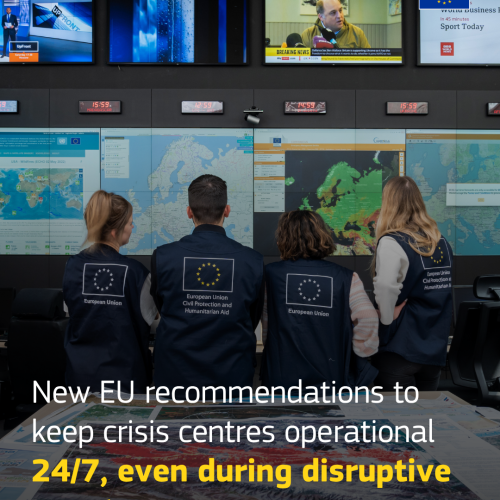
The Recommendation aims to help Member States and UCPM participating states strengthen the resilience of their national contact points through operational continuity so that they remain available round the clock.
The Union’s civil protection systems have faced unprecedented challenges in recent years, from the COVID-19 pandemic and Storm Éowyn in Ireland in January 2025, the blackout in the Iberian Peninsula in April 2025 and Russia’s ongoing war of aggression against Ukraine. These events showed why the UCPM must be able to keep operating 24/7 under all circumstances.
The UCPM legal framework already requires availability 24 hours a day 7 days a week of both the ERCC (Article 7 of Decision No 1313/2013/EU) and the designated national contact points in Member States and participating States to the UCPM (Article 3 of Implementing Decision (EU) 2025/704)).
The guidelines on operational continuity and stress-testing
The new Recommendation is a voluntary, non-binding instrument that gives practical guidance on meeting these commitments. It covers two main areas: operational continuity planning and regular stress-testing. It advises on how to identify essential functions, map the resources and dependencies needed to sustain them, and define prevention and mitigation measures, including alternative arrangements for facilities, power supply, information and communications technology (ICT) systems and human resources.
The Recommendation promotes training, exercises and stress tests to identify gaps and strengthen preparedness. It invites national contact points to test their ability to remain operational during prolonged power outages, ICT failures, damage to premises or their temporary unavailability, or major staff shortages. Several Member States and UCPM Participating States have already carried out such stress tests, and the ERCC itself conducted a stress test in spring 2025.
This initiative stems from Disaster Resilience Goal 5 and implements Action 51 of the EU Preparedness Union Strategy, which calls for EU-wide guidelines on stress-testing emergency response and crisis centres.