Shaping the Future of Host Nation Support in Germany: Diverse Expertise Joins Forces in Bonn to Develop a New Concept
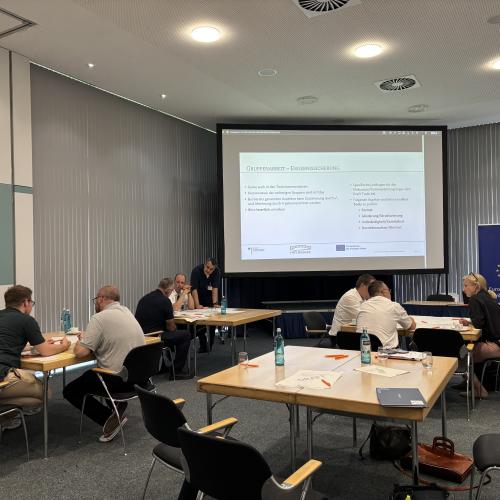
On 23rd and 24th June 2026, the first workshops on toolbox development and training concept for HNS staff took place in Bonn. They were hosted by the Federal Office of Civil Protection and Disaster Assistance (BBK) as part of the project HNS BridGER (Bridging Legal Frameworks and Practical Readiness in Host Nation Support), co-funded by the European Union.
Participants were nominated experts by federal institutions, federal states, and acknowledged aid organizations in German civil protection with in-depth knowledge of HNS from operational and conceptual perspectives. Moreover, HNS experts from Austria and Switzerland participated in the event to facilitate international knowledge exchange on HNS.
HNS toolbox development
On the first day of the workshops, experts were invited to share their knowledge and expertise to review and refine a set of draft tools prepared by the BBK project team. The tools focus primarily on the areas of operational execution and information management within the framework of Host Nation Support for UCPM missions.
Designed to become part of the project’s operational toolbox, the materials include checklists, templates, and practical guidance for key HNS functions, such as managing a Base of Operations or operating a Reception and Departure Centre. During the workshops, participants provided valuable feedback and recommendations to improve the draft tools. The project team subsequently incorporated these contributions, further developing the tools into practical resources ready to support international assistance in Germany.
Development of a training concept for HNS staff
On the second day of the workshops, experts in UCPM training development and HNS collaborated to design the foundations of a comprehensive training concept for HNS personnel. Through interactive brainstorming sessions, participants identified the key training modules and lessons required to equip prospective HNS staff with the skill set needed to efficiently fulfil their role. The proposed topics were grouped by theme and discussed in plenary to establish common priorities.
Building on these results, participants worked together to define the learning objectives, content, and delivery formats for each session. The workshop concluded with the development of a draft curriculum, drawing on the experience of training specialists. This curriculum will serve as the foundation for further refinement by the project team ahead of the next workshop, scheduled for November.
The workshops were co-funded by the European Union. Responsibility for its content lies solely with the Federal Office of Civil Protection and Disaster Assistance and the participants of the workshops; the content does not necessarily reflect the views of the EU.
1 Like