
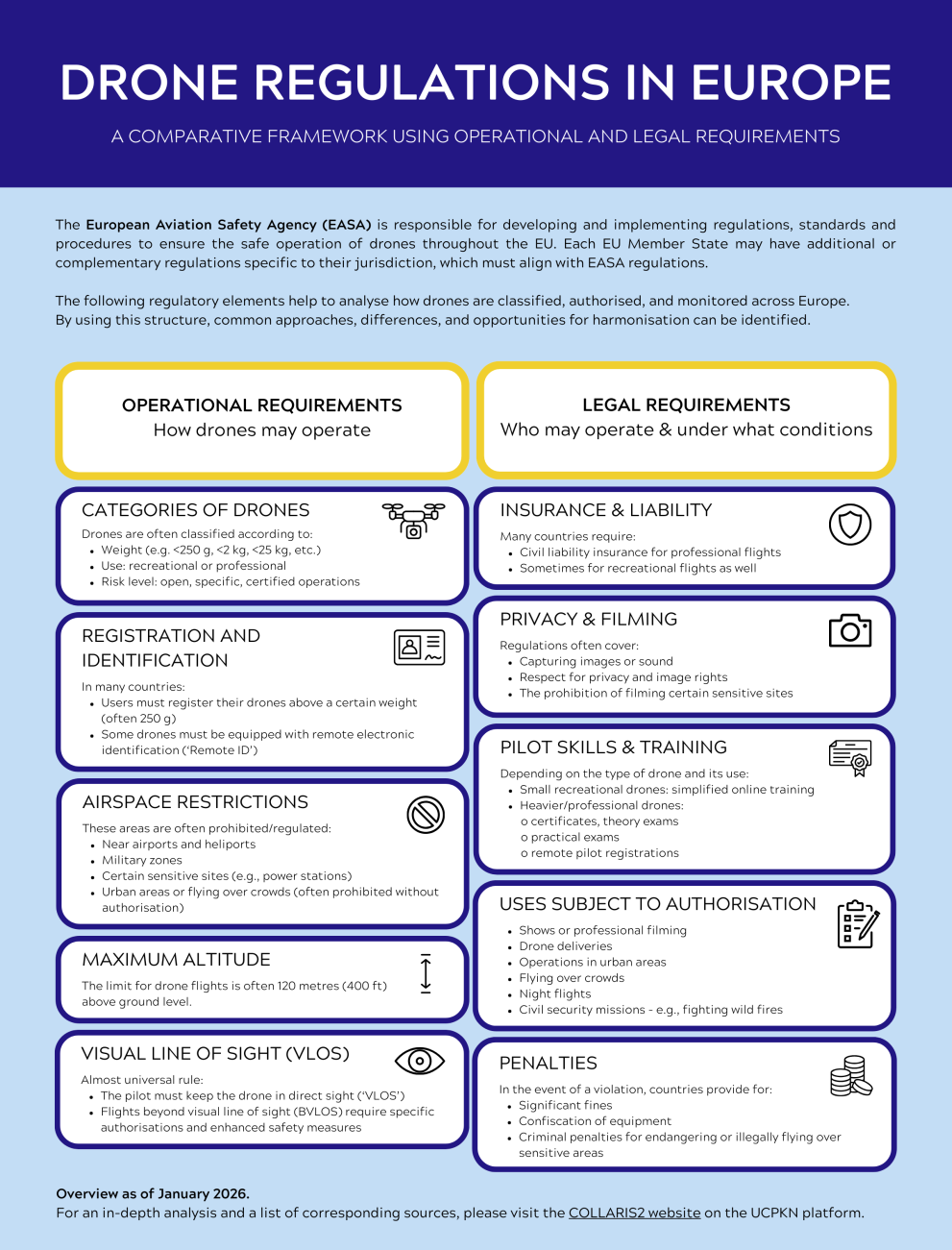
The COLLARIS Network is excited to publish a new report providing a structured overview of the national drone regulations currently in place in different EU Member States (and the UK). These regulations, of course, strongly influence civi protection and emergency response with drones being increasingly used for reconnaissance, victim assessment and many other tasks.
While the overall regulatory framework is largely harmonised through the work of the EASA (European Union Aviation Safety Agency), the report finds that practical implementation still varies across countries. These differences often stem from national exemptions or specific authorisations granted to civil protection authorities. For example, some countries apply stricter rules to protect people and property (which can slow down operational deployment) while others enable more flexible use in emergencies.
Be sure to check out the full report on the COLLARIS2 project website on the UCPKN platform ('Outputs & Results')!
Shared European Framework Since 2021
Despite these variations, the common European regulations, particularly those in force since December 2021, provide a strong foundation. They ensure that:
- The same core rules apply across Member States
- Requirements are based on operational risk rather than purpose
- Interoperability between countries is significantly improved
This harmonisation is a key enabler for joint missions and cross-border cooperation in disaster response. The report makes it clear: Europe is moving in the right direction, but alignment in practice is the next step. One proposed way forward is joint European exercises to test and refine procedures.
About COLLARIS2
COLLARIS (COLLaborative network on unmanned AeRIal Systems) focuses on the use of UAS (e.g., drones) in the field of civil protection and disaster management. Building upon the results of COLLARIS, the EU-funded COLLARIS2 project aims to continue, expand and further develop the already established international network of crisis management and civil protection practitioners, research institutions and public administration. The members of the network collect and transfer knowledge, exchange experiences, skills, good practices and information on operational procedures for the optimal use of drones in crisis management and rescue missions.