What are the key challenges Greece faces in civil protection and disaster relief?
Greece faces several major civil protection challenges, with wildfires and earthquakes among the most prominent. In recent years, the climate crisis has intensified natural hazards, making extreme events more frequent and severe, and requiring continuous adaptation of preparedness and response mechanisms. Our main priority is to strengthen national resilience by investing in prevention, preparedness and risk reduction while also enhancing operational response capacities. Equally important is reinforcing cooperation across government and with local authorities.
Greece’s experience with large‑scale disasters has also demonstrated the crucial role of the UCPM. When facing extensive emergencies, solidarity and support from other European countries through the Mechanism are invaluable.
How did your Ministry for Climate Crisis and Civil Protection adjust its strategies post‑2021 disasters to emphasise prevention and resilience?
The year 2021 marked a turning point, mainly due to devastating wildfires that affected several parts of Greece. In response, the government established the Ministry for Climate Crisis and Civil Protection, elevating civil protection to a dedicated ministerial level. The General Secretariat for Civil Protection was integrated into the new ministry, strengthening coordination, preparedness and strategic planning.
Greece also participates in the EU pre‑positioning programme for European firefighters, hosting international teams in summer, which further boosts readiness and cooperation under the UCPM.
How has the Greek General Secretariat contributed to the UCPM Deployable Training Programme?
UCPM training is dynamic and evolves with operational needs and emerging risks. Each year, the European Commission holds Lessons Learned meetings after major emergency seasons, where countries share experiences and identify improvements; these inputs are integrated into course updates, ensuring the programme stays relevant. In this context, the General Secretariat contributes by sharing Greek operational experience and best practices and remains available to support the Commission and consortium partners with expertise that strengthens Europe’s collective disaster‑response capacity.
How has Greece’s participation in UCPM training strengthened national capacities?
Greece aims to stay actively engaged in the UCPM, and training is one of its most important pillars. Greece regularly sends experts and practitioners from various services to these courses, which strengthens their knowledge and operational readiness and helps build professional networks with colleagues from other countries. This involvement ensures that Greek experts are prepared to contribute as individuals and as part of operational modules both in Greece and abroad.
How do you see Greece’s role expanding in UCPM training and deployments across all risks?
Greece monitors developments across Europe and globally and aims to support partner countries whenever possible, especially by contributing strong operational capacities in wildfire response, where it has extensive experience. Greece also participates actively in the EU pre‑positioning programme, both by hosting European firefighting teams and by deploying its own teams abroad. Within training, Greece is pleased to participate as a consortium partner and already hosts courses such as the Deployment Capacities Course (DCC), and remains open to hosting additional courses in the future to further develop expertise under the UCPM.
What has been your own most valuable learning from the DCC held in Athens recently?
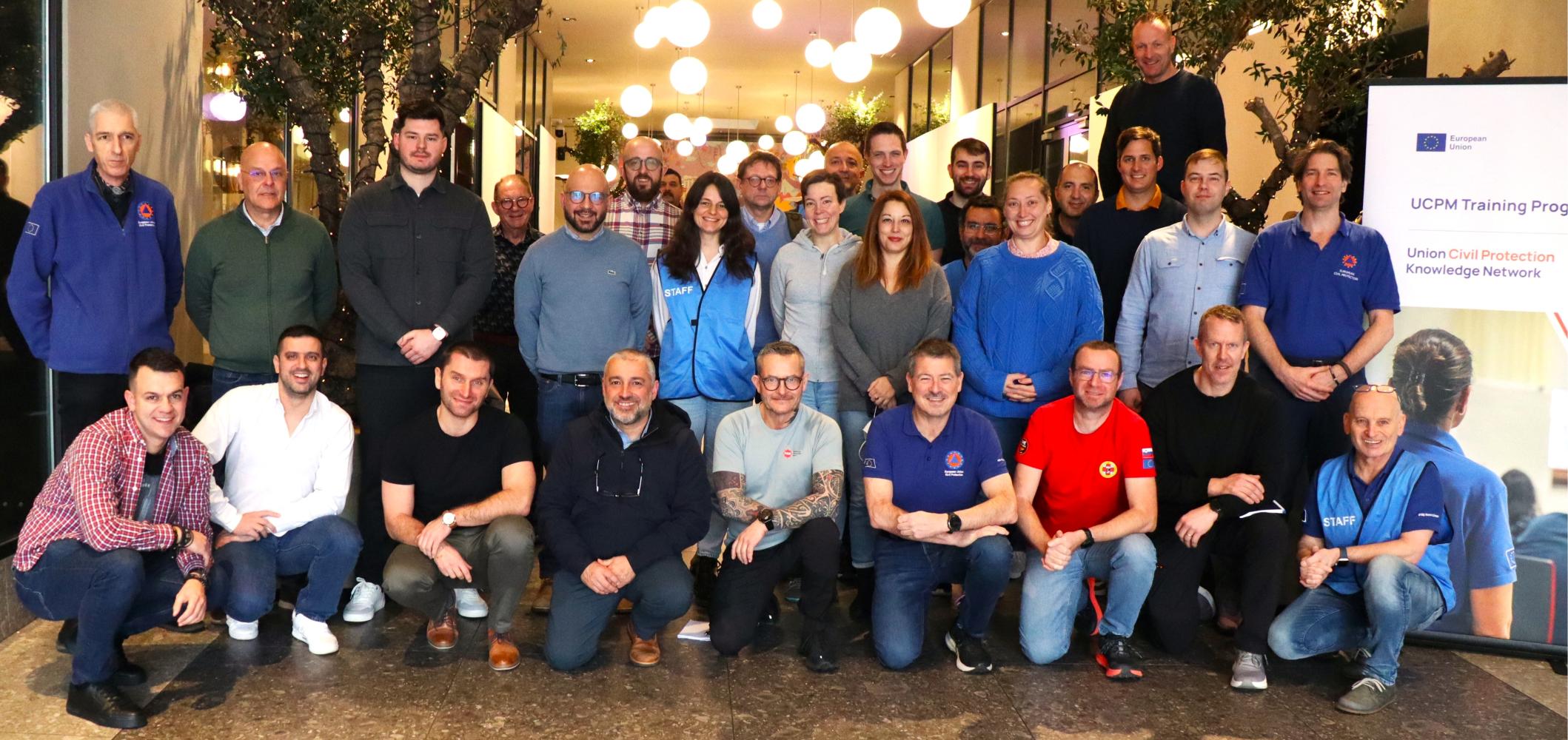
The DCC course held in Athens in January underlined that disasters do not respect borders, timing or predictability. During the course, Athens experienced an intense rainstorm, showing how quickly conditions can change and how important it is for civil protection systems to remain constantly prepared. While delivering the training, national authorities had to stay fully alert and ready to respond if needed. And responding at the very night of intense flooding in parts of Athens, some of the Greek course facilitators did! This highlighted the importance of flexibility, coordination and adaptability, both in training and in real operations. Ultimately, it reinforced our core principle: preparedness must always go hand in hand with the ability to adapt quickly to unexpected events.
Interested in the UCPM Deployable Training Newsletter? Let us know info@tvc-academy.eu