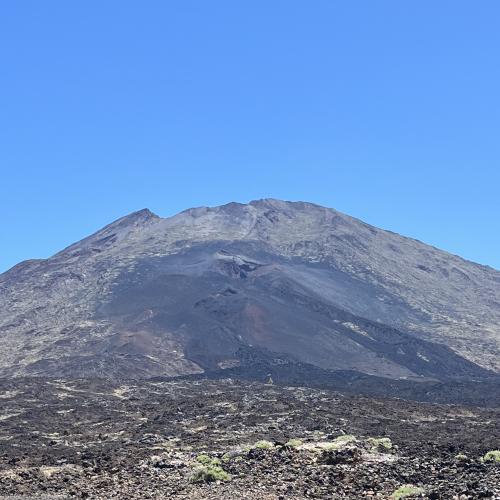
From October 13 to 17, members of the Natural Risks Assessment Service (NRAMS) which form part of the VOLCAN Project, together with researchers of the Institute of Earth Sciences (ISTO) of the French National Centre for Scientific Research (CNRS) in Orleans (France) participated in the collection of samples of products from past eruptions of the Teide-Pico Viejo volcanic complex on the island of Tenerife, for subsequent study using experimental petrology techniques. Petrology is understood as the branch of geology that studies rocks. Using different scientific methods, it is possible to infer information such as which minerals form the rock, its age, under which conditions of temperature and pressure they were formed, among others.
The purpose of this study will be to understand the pre-eruptive conditions of this volcanic complex and the likelihood of future eruptions. Although our knowledge of the eruptive past of the Teide-Pico Viejo volcanic complex is improving, allowing us to predict its possible future eruptive style with an acceptable degree of accuracy, determining the mechanisms that lead this volcanic complex to a new eruption and when one might occur remains a pending issue. The collaboration between these two working groups, already long-standing, will allow the application of cutting-edge techniques, unavailable in Spain, to determine under which conditions Teide and Pico Viejo volcanoes prepare for a new eruption, and thus inferring what early warning signs should be expected in the event of a new reactivation. This is the fundamental preliminary step to getting a little closer to the still-impossible dream of predicting volcanic eruptions.
The aim of the study was to better understand the pre-eruptive conditions of this volcanic complex and assess the likelihood of future eruptions. Although knowledge of the eruptive history of the Teide–Pico Viejo volcanic complex had improved, enabling more accurate predictions of possible eruptive styles, the mechanisms that trigger new eruptions and their timing remained unresolved.
This long-standing collaboration between the two research groups made it possible to apply state-of-the-art techniques not available in Spain to determine how the Teide and Pico Viejo volcanoes prepare for new eruptions. These results helped identify potential early warning signs of future reactivation, representing an essential step toward the long-term goal of improving volcanic eruption forecasting.