Presentation of the CoP
The FASTER Community of Practice has been developed by the FASTER project to bring together stakeholders involved in earthquake preparedness, rapid impact assessment, civil protection decision-making, emergency response, infrastructure resilience, and the development of Rapid Response to Earthquake tools.
FASTER focuses on improving how Rapid Response to Earthquake tools are understood, used, shared, and developed across Europe and neighbouring countries. These tools provide early estimates of earthquake impacts, such as likely damage to buildings, affected populations, infrastructure disruption, and potential operational consequences. This information can support faster decision-making during the critical first hours after an earthquake.
The Community of Practice provides a shared space for practitioners, authorities, researchers, tool developers, infrastructure operators, and European-level coordination actors to exchange knowledge, discuss needs, share good practice, and contribute to more harmonised and interoperable approaches to rapid earthquake impact assessment.
Through this Community of Practice, FASTER aims to:
- strengthen cooperation between countries and organisations working on earthquake preparedness and response;
- improve understanding of the capabilities and limitations of existing Rapid Response to Earthquake tools;
- support the use of early impact assessment information by civil protection and emergency management actors;
- identify user needs across different levels of decision-making and response;
- promote more consistent indicators, formats, procedures, and guidance;
- support the long-term visibility and uptake of FASTER results through CMINE and the Disaster Risk Stakeholder Hub.
Groups of Practice
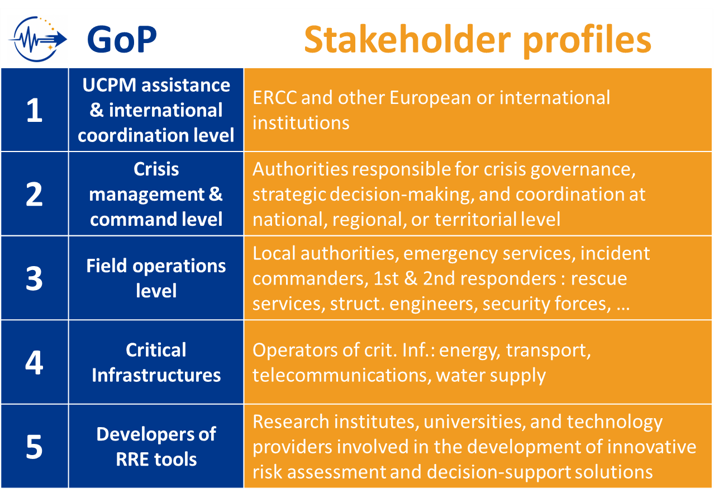
The FASTER Community of Practice is structured around five Groups of Practice. Each Group of Practice represents a different stakeholder perspective and has its own dedicated page within the CoP.
Members are encouraged to remain part of the wider Community of Practice, while paying particular attention to the Group of Practice most relevant to their role, expertise, or organisation. Cross-cutting participation is also encouraged, as the value of the CoP comes from connecting strategic, operational, technical, infrastructure, and scientific perspectives.
The dedicated Group of Practice pages will be used to share targeted information, resources, discussions, and updates relevant to each stakeholder group. Announcements and posts may also be tagged to the relevant Group of Practice so that members can easily follow the topics most relevant to them.
GoP 1 — UCPM assistance and international coordination level
This Group of Practice focuses on European and international coordination, represented by the Emergency Response Coordination Centre (ERCC) and other European or intergovernmental institutions involved in civil protection assistance, situational awareness, and cross-border response coordination.
It considers how Rapid Response to Earthquake (RRE) data and early impact estimates can support European-level analysis, improve shared situational awareness, inform international assistance coordination, and contribute to future interoperability between national RRE tools and EU-level systems.
GoP 2 — Crisis management and command level
This Group of Practice is aimed at authorities responsible for crisis governance, strategic decision-making, and coordination at national, regional, or territorial level.
It focuses on how early earthquake impact assessments can support command-level decisions, including contingency planning, prioritisation of resources, requests for assistance, activation of emergency plans, coordination between authorities, and the translation of technical impact information into actionable crisis management decisions.
GoP 3 — Field operations level
This Group of Practice is aimed at local authorities, emergency services, incident commanders, first and second responders, rescue services, structural engineers, security forces, and other organisations involved in operational earthquake response activities.
It focuses on how Rapid Response to Earthquake outputs can support field operations, including operational planning, early sectorisation, deployment decisions, reconnaissance, damage assessment, rescue prioritisation, incident command, and field-level situational awareness.
GoP 4 — Critical infrastructures
This Group of Practice is aimed at critical infrastructure operators and relevant stakeholders responsible for essential services, including energy, transport, telecommunications, water supply, and other infrastructure systems that may be affected by earthquakes.
It explores how early earthquake impact information can support infrastructure preparedness, continuity planning, prioritisation of inspections, service restoration, damage assessment, and coordination with civil protection and crisis management authorities.
GoP 5 — Developers of RRE tools
This Group of Practice is aimed primarily at research institutes, together with technical experts, scientists, developers, and organisations involved in designing, operating, improving, or evaluating Rapid Response to Earthquake tools.
It focuses on the technical development of RRE systems, including interoperability, indicators, data exchange, user requirements, functional improvements, uncertainty, modelling, validation, and future research priorities. It also supports dialogue between tool developers and end-users to ensure that RRE tools are aligned with operational needs and decision-making requirements.