

New technologies such as drones, ground robots and AI offer significant potential to support emergency responders. They can help assess hazardous environments, collect information and provide a better picture of an unfolding incident. Yet, as discussions at Session 12 – “Innovations for crisis management: bringing drones and ground robots into action” during this year’s European Civil Protection Forum in Brussels highlighted, developing a promising technology is only the first step. Making it work reliably in real operations requires much more: appropriate procedures, trained personnel, interoperability and a clear understanding of operational needs.
Moderated by Christian Resch, Managing Director of the Disaster Competence Network Austria (DCNA), the session brought together four experts representing different perspectives and European research projects: Jakub Ryzenko, Head of the Crisis Information Centre at the Space Research Centre of the Polish Academy of Sciences, CBK PAN (COLLARIS2); Pierre Ferrandini, Commander at SIS2B (HURRICANE); Robbert Heinecke, Robotics & Innovation Expert and Co-Founder and CEO of Futurised (TRIFFID); and Eva Leroux, Business Developer at CS GROUP (CARMA).

Building a community around drone operations
Representing COLLARIS2, Jakub Ryzenko highlighted that access to new technology does not automatically mean that organisations are able to use it effectively in an emergency. Internal procedures, operational knowledge and the ability to coordinate activities (ait traffic management) are equally important. COLLARIS2 addresses these challenges by bringing stakeholders together to exchange experiences, test new approaches (e.g., during field trials), share methods and strengthen skills related to the use of drones in civil protection.
Ryzenko also pointed to two major challenges for drone deployment. First, flight safety and air traffic management remain significant obstacles, particularly when drones need to operate alongside other (manned) aircraft. Second, information gathered by drones needs to be shared and presented in a way that helps incident commanders and other responders make decisions. Drones should not simply provide aerial images; their information needs to reach the people who can act on it.
Experiences from Poland illustrate the importance of coordination: During the 2024 floods, hundreds of drone flights were conducted safely alongside helicopter operations, requiring close coordination and airspace management. Ryzenko stressed that practical learning, demonstrations and training incident commanders can help generate demand for drone capabilities and gradually support their operational deployment.

From successful trials to operational uptake
A central question throughout the session was how to bridge the gap between technology development and routine operational use. The discussion identified several priorities:
- Training and learning: Emergency responders and incident commanders need opportunities to experiment with technologies and learn how to work with them.
- Flexible and complementary robotic capabilities: Rather than relying on a single type of robot, organisations should be able to deploy fleets of different robotic platforms and select the most suitable system for each operational environment and task.
- Interoperability: Robotic systems must connect with existing command structures, communication channels and operational procedures.
- Reliable and practical solutions: Technologies should address clearly identified needs and be tested in realistic (challenging) conditions. Simple, task-specific solutions may be more useful than complex systems that are difficult to operate. Technology should act as a companion to emergency responders, not create additional complexity.
- Regulatory frameworks: Clear rules are needed to enable safe drone operations and address emerging questions around autonomous systems. For ground robots, for instance, there is a lack of clear regulations for their operational use.
- Cooperation and investment: Stronger involvement of industry and continued collaboration beyond individual research projects are essential to bring technologies closer to operational maturity.
The discussion also highlighted that civil protection organisations differ considerably in their resources and levels of technical expertise. Solutions and training approaches, therefore, need to take account of different types of users, including the important role of volunteers.
The audience's perspective: From current use to future priorities
Interactive Slido polls brought the audience directly into the discussion, with participants representing civil protection and emergency response organisations, public authorities, research and technology development. The results showed that drones are already operationally deployed in many organisations: 50% of respondents reported operational use, while another 20% said they were currently used in trials or exercises. Ground robots, by contrast, are less established, with only 15% reporting operational use in their organisations.
When asked about the greatest operational value of these technologies, participants identified rapid situational awareness and mapping as the leading priority (75%), followed by hazard detection and monitoring and the inspection of places that are unsafe or inaccessible to responders.
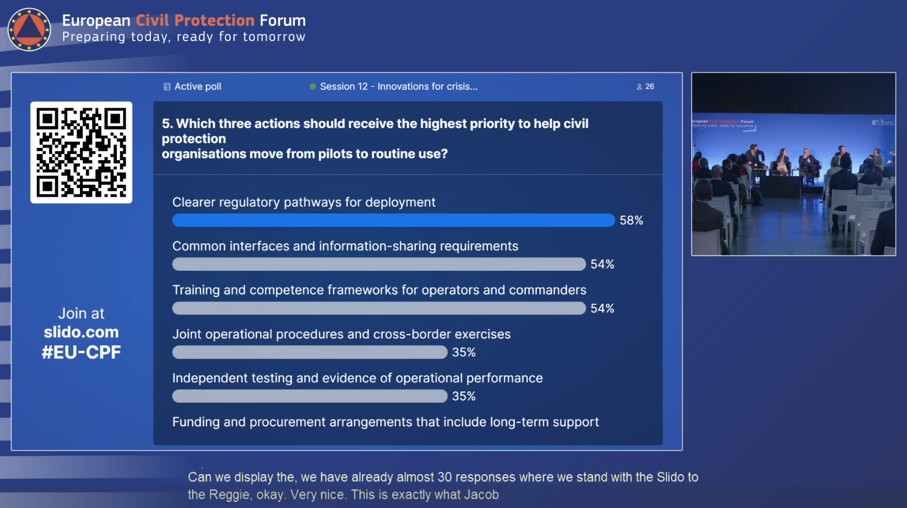
The polls also highlighted the main obstacles and priorities for wider deployment. Acquisition costs and ongoing support and regulatory requirements or deployment permissions were among the most frequently identified barriers. Looking ahead, participants placed the highest priority on clearer regulatory pathways, common interfaces and information-sharing requirements, and training and competence frameworks for operators and commanders.
Continuing the learning cycle
These results reinforced a central message of the session: The challenge is no longer simply to demonstrate what the technology can do, but to create the conditions that allow civil protection organisations to use it safely, effectively and routinely.
Another takeaway from the session was that the transition from innovation to operations is not a one-off process. It requires continuous interaction between operational needs, technology development, testing and practical experience. Each exercise and mission can generate lessons that feed back into the development and improvement of solutions. The session demonstrated why this exchange between researchers, technology developers and practitioners is essential if innovation is to deliver real value for emergency response.
About COLLARIS2
The EU-funded project COLLARIS2 is the successor to COLLARIS (COLLaborative network on unmanned AeRIal Systems) and focuses on the use of UAS (e.g., drones) in the field of civil protection and disaster management. Building upon the results of the COLLARIS Network, this project aims to continue, expand and further develop the already established international network of crisis management and civil protection practitioners, research institutions and public administration. The members of the network collect and transfer knowledge, exchange experiences, skills, good practices and information on operational procedures for the optimal use of drones in crisis management and rescue missions.