UCP Knowledge NetworkApplied knowledge for action
Foresight workshop

Looking to 2036: future risks for civil protection and humanitarian aid

By Knowledge Network – Staff memberPublished on

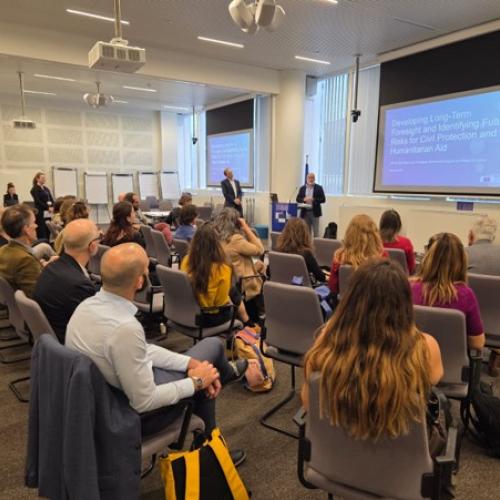
On 28 September, DG ECHO staff and external experts spent a day in Brussels with the EU Policy Lab of the European Commission’s Joint Research Centre (JRC). They explored how foresight could support civil protection and humanitarian preparedness today.
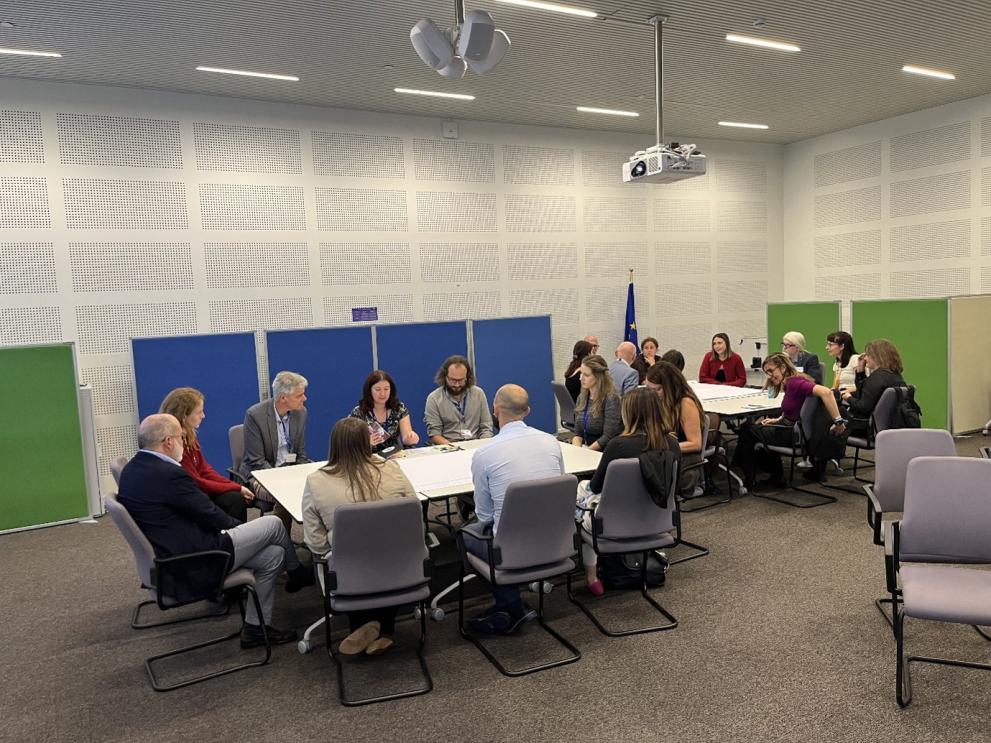
The day was hosted by the JRC’s EU Policy Lab (Unit S.1) in collaboration with DG ECHO. Participants came from across DG ECHO and other Commission services. Researchers and practitioners joined them from the UN Office for Disaster Risk Reduction (UNDRR), OCHA’s Centre for Humanitarian Data, the OSCE, the International Institute for Applied Systems Analysis (IIASA), the Interagency Research and Analysis Network, the Centre for Security Policy Studies of King’s College London, the University of Cambridge’s Centre for the Study of Existential Risk, the University of Tartu as well Technische Universität Braunschweig.

Foresight is not prediction but a preparedness tool

Thomas Hemmelgarn, Head of the EU Policy Lab, presented foresight as a complement to risk assessment and forecasting that can effectively support ECHO’s operational mandate. For example, using foresight methodologies such as scenarios to stress-test policies in different futures or horizon scanning to spot emerging changes can inform crucial decisions on stockpiling strategies and capabilities to develop before the start of the next crisis. 

Dr Delia Mangelkramer of Technische Universität Braunschweig presented STRATOS, a project funded by Germany’s Federal Office of Civil Protection and Disaster Assistance (BBK). It brings foresight into German civil protection at every level of government, from federal to local. The barriers she described may be familiar across Europe: foresight work can be scattered, staff rarely have time for it, and its findings often stop at analysis instead of shaping decisions.

From weak signals to futures wheels

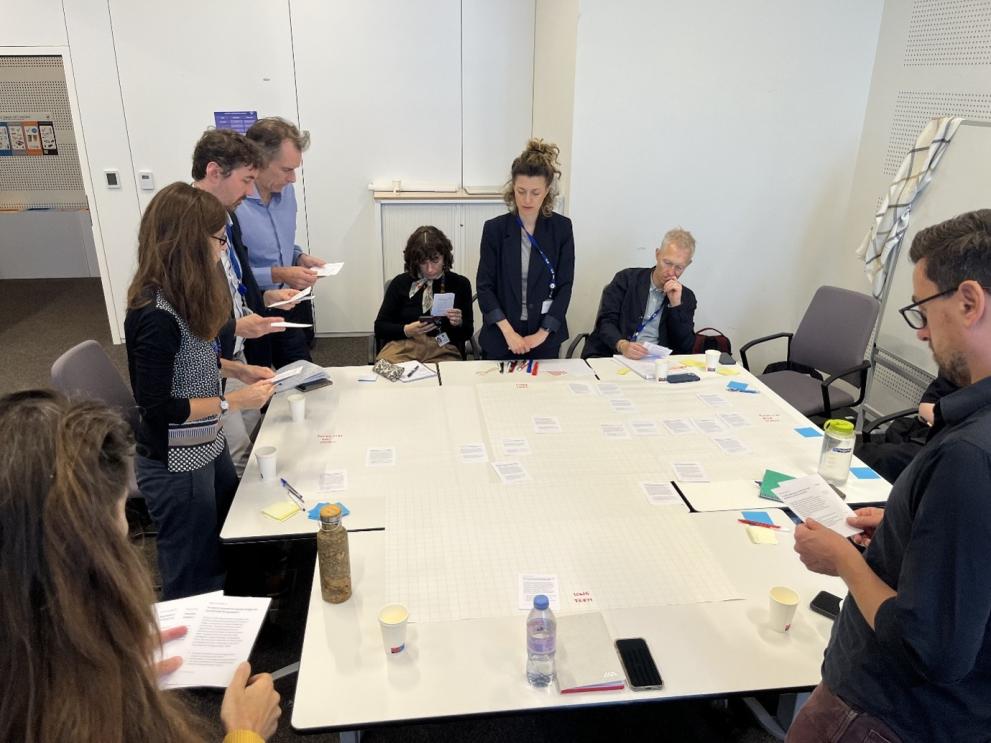
Before the workshop, participants and facilitators gathered 60 “weak signals”. The JRC defines these as early signs of change that most experts and policymakers have not yet noticed. Groups then picked one and traced its systemic cascading effects using futures wheel.

One civil protection group looked at people leaving high-risk areas because of climate change. Deeper inequality came first. Then a harder question: who decides which areas count as risky (a choice that could become highly political)?

A humanitarian group imagined a world running out of water, with rising food prices and even wars over water. Its mitigation ideas included education about water in every school.

Common ground

The main objective of the day was to familiarise ECHO colleagues with foresight methodologies to build a shared understanding of how foresight could be embedded in ECHO’s work. Foresight processes are tailored endeavours which often include a joint scoping phase of the issue, accompanied by other steps, such as desk research, participatory workshops and experts reviews. 
Asked where they could use foresight in their own work, ECHO colleagues named the implementation of the Preparedness Union Strategy, EU risk assessments, decisions on future programmes and the response capabilities needed at EU level. The EU Policy Lab will share the workshop materials with participants