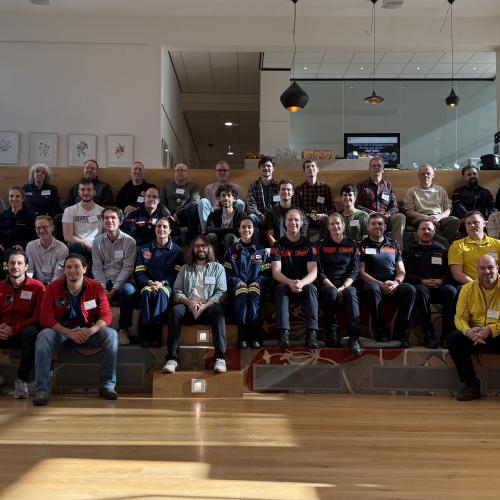
The training brought together researchers and wildfire professionals to deepen their understanding of the interaction between atmospheric conditions and extreme wildfire behaviour. Building on previous training activities under the EWED project, ODET’s precursor, this edition combined novel science and knowledge, practical exercises and real wildfire case studies.
From atmospheric processes to real wildfire scenarios
Participants explored applied meteorology, including atmospheric structure, boundary layers, rising wildfire plumes and entrainment. They then analysed past wildfire events, examining plume development and different types of pyroconvection.
The training concluded with a realistic scenario exercise, allowing participants to apply the knowledge gained throughout the sessions.
Learning across countries and disciplines
Beyond the technical content, the training created opportunities to exchange experiences from different wildfire contexts. Participants shared lessons from recent fire seasons, highlighting the value of learning from one another.
Zisoula Ntasiou, from Hellenic Fire Service and a participant who had also attended the previous year’s training, reflected on the progress made: “We attended the training last year, and this year we found that the content had advanced further. Every year, we learn something new. Exchanging knowledge and experience with other countries is especially valuable, both operationally and scientifically. What we learn from other countries can help us prepare for similar situations at home.”
The discussions also addressed the use of simulations and modelling tools to analyse extreme wildfire behaviour. Although these tools are still evolving, they can support decision-making when combined with information gathered on the ground.
As Ntasiou herself explained, “when a decision has to be made, you don’t need perfect information or a perfect model, because neither exists. You need the best available information, combined with data from the ground. These models are still being developed, which is precisely why it is important to use them, learn from them and help improve them.”
Strengthening collaboration for future challenges
For ODET, connecting scientific knowledge with operational experience is key to improving preparedness for extreme wildfire events.
As Jonathan Troncho, member of the project coordination team at the Pau Costa Foundation, explains, “addressing extreme wildfire events requires both scientific knowledge and operational experience. By bringing these perspectives together and learning from one another, we can strengthen our collective understanding and preparedness. Training initiatives like this help turn shared knowledge into a stronger basis for anticipating and responding to extreme wildfires.”
The training featured contributions from Wageningen University & Research (WUR), the Catalan Fire and Rescue Service (Bombers de la Generalitat de Catalunya), the Nederlands Instituut Publieke Veiligheid (NIPV), D.R.E.Am Italia and the Pau Costa Foundation, alongside wildfire professionals from different countries.
By combining scientific learning, practical exercises and international exchange, the ODET training series supports a collaborative approach to understanding extreme wildfire events.