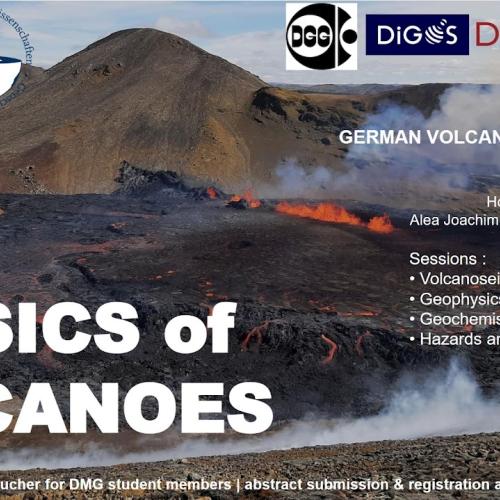
This year’s workshop featured a scientific programme combining oral presentations and poster sessions. Discussion panels were also organised to explore potential collaborations between working groups within the German scientific network Geo.X. The event included a social programme that encouraged interaction among participants during breaks and at the joint dinner held on Thursday 19 February. A volcanic photography contest was also organised, and the dates and location of the next POV edition were announced: University of Freiburg (Germany), 24–26 February 2027.
Iris Schneider-Pérez, a member of the VOLCAN Project and who is currently doing a pre-doctoral research stay at the Helmholtz Centre for Environmental Research (UFZ) in Leipzig (Germany), also presented a poster entitled “Volcanic Risk Communication in Tenerife (Canary Islands): Addressing the Challenges of Multi-Hazard and Uncertainty Communication”. In this first phase of the project, Schneider-Pérez identified the main actors involved in volcanic risk management in Tenerife and their respective roles. To gather this information, she carried out the following tasks:
- Reviewing the volcanic risk management plans which apply to the island.
- Attending the first volcanic eruption drill organised in Spain, held in the municipality of Garachico (Tenerife) during the week of 22 September 2025, which enabled direct contact with key stakeholders.
- Interviewing a total of 15 individuals involved in volcanic risk management in Tenerife.
Among the actors identified, Schneider-Pérez highlights the need to better integrate three key profiles:
- Legal consultants (e.g., lawyers), who can provide advice during decision-making processes and assess legal implications.
- Psychology professionals, to provide emotional support.
- The creation of a specialised risk communication unit, both during periods of normality and crisis.
Key conclusions from the work include:
- The importance of communicating science to support informed decision-making.
- The need to adapt risk communication to the specific audience or stakeholder group.
- The importance of strengthening risk communication during periods of calm in order to foster a culture of prevention.
The next step of the research will be to analyse how the different actors interact, which communication channels they use, and how these relationships are structured.
Iris Schneider-Pérez describes her experience at POV as very positive and highlights the high scientific level of the contributions presented. Exchanges with other researchers during the workshop will allow her to incorporate new ideas and suggestions into her work. She also emphasises that, beyond the scientific sessions, enriching discussions emerged on how to quantify and communicate scientific uncertainties related to volcano research. These reflections highlighted the role of the scientific community in supporting populations living near active volcanic systems.
Acknowledgements
The poster study presented at POV was made possible thanks to the VOLCAN project, funded by European Civil Protection and Humanitarian Aid Operations (ECHO) of the European Commission (EC) (ref. 101193100). Travel and participation costs were funded by the Department of Monitoring and Exploration Technologies (MET) at UFZ.