The activity was organized within the framework of the VOLCAN project, which aims to review the Canary Islands’ volcanic emergency plan, PEVOLCA, and formulate proposals for its improvement.
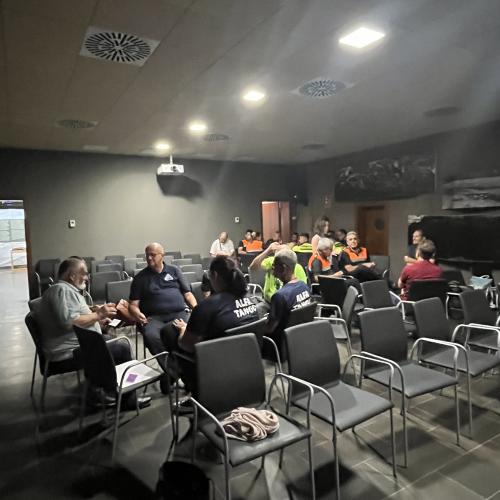
The workshop, held from 9:30 a.m. to 1:00 p.m. at the Caños de Fuego and Cueva de Las Palomas Volcanic Caves Interpretation Centre, brought together representatives and members of different organizations and emergency response services, including Civil Protection, fire brigades, the Red Cross, the Rescue and Emergency Unit (Salva-Emer), and the Cabildo de La Palma.
Dr. Joan Martí Molist opened the workshop with a brief presentation of the VOLCAN project and an introduction to several concepts related to volcanic risk assessment and management. Dr Marta López Saavedra then introduced and led the participatory activity.
For the practical exercise, participants were divided into three groups, taking into account the similarities between the different emergency response services and areas of intervention. Using sticky notes and A3 sheets, each group identified and discussed the main challenges and needs they encounter in volcanic emergency management. The experience of the 2021 eruption in La Palma served as one of the main points of reference for reflection and the exchange of experiences.
Among the main challenges identified were difficulties in communication and coordination between the different emergency response services and emergency management structures, managing the uncertainty associated with volcanic crises, and the long-term consequences of emergencies, both in terms of territorial recovery and the emotional toll on the population and emergency response teams. Participants also highlighted the difficulties faced by professionals in the Canary Islands in accessing specialized training in volcanic risk management.
Regarding the main needs identified, participants highlighted the importance of strengthening specialized training, better defining the roles and responsibilities of the different stakeholders involved, and conducting more emergency exercises under conditions similar to those of a real emergency. They also stressed the need to evaluate the actions taken following an emergency and incorporate the experiences of affected communities and emergency response teams to improve preparedness for future volcanic events.
Participants gave positive feedback on the workshop. Among the main concluding reflections was the need to promote more participatory spaces of this kind.
As part of the VOLCAN project, this participatory activity has also been carried out on other islands of the Canary archipelago, and a new workshop is planned in Lanzarote. Together, these activities will provide information that will contribute to the development of proposals aimed at improving the Canary Islands’ volcanic emergency plan.