The potential of serious games for increasing wildfire resilience in Europe
By Adriana Solovei (Postdoctoral Researcher) and Cathelijne Stoof (Associate Professor), Wageningen University and Research

By Adriana Solovei (Postdoctoral Researcher) and Cathelijne Stoof (Associate Professor), Wageningen University and Research
Wildfires are a growing environmental challenge across Europe, with over one million hectares of land burnt in 2025 alone, preceded by high-record years in 2017, 2021, 2022 and 2023. The intensity and frequency of wildfires are projected to increase, not only in the traditionally fire-prone regions of southern Europe but also in temperate areas that have historically had less experience with wildfires. Yet, in many European countries, there is still a need to improve public awareness and preparedness towards wildfires. When combined with dense populations and expanding wildland–urban interfaces, low levels of awareness and preparedness can lead to serious negative impacts on public health, ecosystems, material assets, and even loss of lives.
However, fire is also a natural element of many landscapes that cannot be completely avoided. In fact, if managed carefully, fire can be beneficial to ecosystems that have evolved with fire by stimulating regeneration and biodiversity. Also, paradoxically, too much focus on suppressing fire can eventually lead to stronger wildfires, due to, for example, long-term accumulation of dry vegetation. Yet, despite evidence that prevention measures (such as mosaic landscapes, grazing, or fire barriers) are cost-effective, most European wildfire budgets still largely focus on fire suppression rather than prevention.
Given these complex dynamics, both citizens and policymakers need a better understanding of wildfire risks and prevention. Educational games, also called serious games, offer an interactive way to build this awareness, complementing more traditional one-way communication campaigns.
Serious games are designed primarily for purposes other than mere entertainment. They integrate various elements of learning by providing players with scenarios that reflect simplified real-world processes.
The pedagogical strength of these games lies in several mechanisms:
In the context of wildfires, game scenarios can focus on a variety of topics, including:
SparkleFire is a project funded by the EU through the Union Civil Protection Mechanism, under the Knowledge for Action in Prevention & Preparedness 2024 programme. Its mission is to use play and educational games to help people across Europe better understand wildfires to be better prepared.
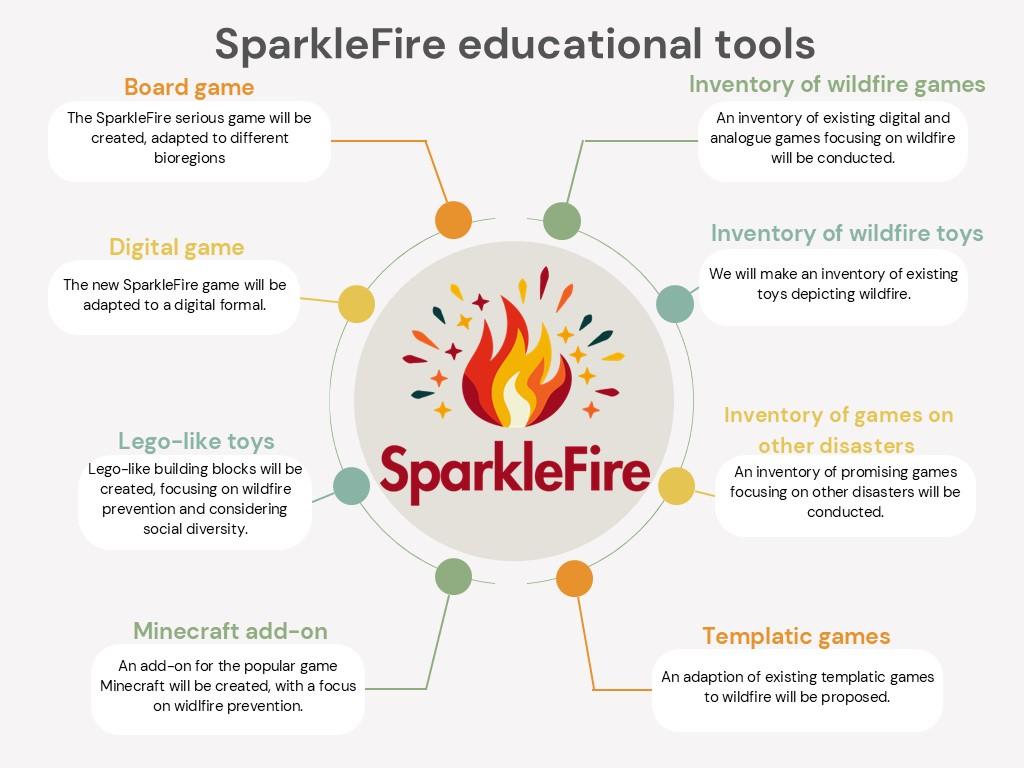
SparkleFire focuses on several core activities (see the figure below):
Europe includes different bioregions, with distinct vegetation patterns and fire regimes. Therefore, a game scenario that reflects the conditions of Portugal or Greece may not fully capture the context of the Netherlands, Slovenia or Norway. To deal with this, SparkleFire aims to use a bioregional adaptation approach, in which game principles are maintained but contextual elements, such as landscape elements and weather conditions, can be tailored to local contexts.
There are several challenges that should be considered when creating games on the topic of wildfires.
To address these challenges, SparkleFire will develop tools in collaboration with the people who will use them. Furthermore, they will be pilot-tested in the four bioregions involved in the project, for example, in schools and community groups, in order to ensure that they work well in practice.
Next to increasing awareness of wildfires at the individual level for players, games can also have a spillover effect, where players share the gained knowledge with their networks. For example, after playing a game at school, children may talk about it with their parents at home. In this way, awareness can be increased at the community level. By inviting players to interpret, discuss, and negotiate scenarios together, games embed learning within social interaction.
Educational (serious) games offer an innovative way to increase awareness about wildfires, by helping players understand the complex dynamics of wildfires and discuss solutions together. For effective reach, it is important to create games that are adaptable or tailored to different contexts and bioregions, in accessible digital and/or physical formats. The impact of educational games can extend beyond individual learning by stimulating dialogue and collective action. Thereby, games can be a powerful tool in building a more wildfire-resilient Europe, and SparkleFire aims to contribute meaningfully to this goal.