Learning by making decisions
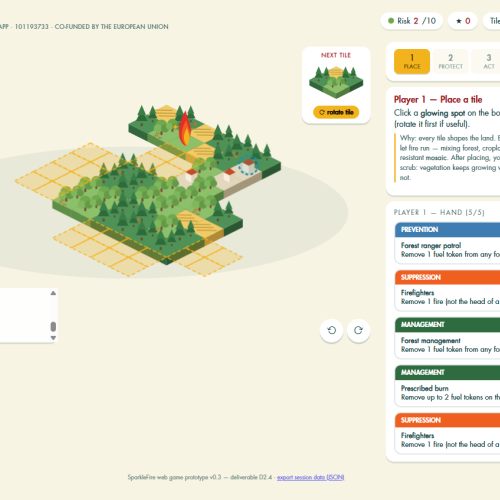
At the centre of this work is the web-based SparkleFire game, developed by VOST Portugal. Rather than asking players to memorise isolated facts, the game places them in charge of a shared landscape. They must work together, choose prevention and preparedness measures, manage limited resources and respond to changing conditions across several seasons.
The important lesson is that wildfire risk is not created in a single moment. It develops through the relationship between vegetation, weather, land use, preparedness and human decisions. Actions such as managing fuel, maintaining agricultural activity, protecting homes or improving community readiness may involve costs today but reduce future losses. By making these trade-offs visible, the game turns an abstract subject into a system that players can examine and discuss.
The web game is being adapted to four European bioregions: Mediterranean, Atlantic, Central European and Northern European. Each has different landscapes, vegetation, weather patterns and relationships with fire. Regional content packs allow these differences to be represented without suggesting that one set of measures applies everywhere. The content is being reviewed with project partners and regional experts, while pilot sessions provide evidence about what learners understand, where they struggle and what should be improved.
More than a digital copy of a board game
The online version extends the educational experience beyond reproducing cards and a board on a screen. It currently includes guided play, a tutorial, different difficulty levels and thirteen short minigames that let learners practise particular skills. These activities cover themes such as identifying hazards, preparing the area around a home and recognising safer choices. They provide immediate feedback, making mistakes part of the learning process rather than the end of it.
Accessibility has been treated as part of the design. Options include high-contrast and colour-vision modes, reduced motion, scalable text and keyboard support. The game can also be installed as a Progressive Web App and used offline after its first visit, which is particularly useful in schools, community settings and rural areas where connectivity may be limited.
Language is another essential part of access. English and Portuguese content is built into the current version, while the architecture supports all 24 official EU languages. Automatically translated language packs are clearly identified as awaiting human review. This distinction matters: technology can broaden initial access, but scientific, educational and linguistic validation remains a responsibility shared by subject experts and native speakers.
Building and reshaping landscapes
SparkleFire also explores familiar forms of play. FireLandCraft is a modification for Minecraft, led by the Municipality of Paredes de Coura, that uses a world already known to many children and young people. Players can create more fire-resilient landscapes and simulate practices such as grazing, agriculture, forest management and vegetation management. Instead of presenting the landscape as a fixed background, the tool shows it as something continuously shaped by social and environmental choices.
Sparkids complements this digital work with interlocking construction pieces focused on landscape management and wildfire prevention. Although it is a physical tool, it follows the same learning philosophy: learners build, test, explain and reconsider. Together, the tools give educators different entry points for different ages, settings and learning styles.
Feedback as part of development
Digital education should not be a one-way transfer of information. The SparkleFire web game therefore includes a feedback questionnaire and a privacy-conscious results dashboard. Feedback can be examined by language, age group, profile, game version and bioregion, helping the project team identify patterns without requiring players to create accounts or provide names. The dashboard runs locally, and the game is designed to minimise the collection of personal data.
This creates a cycle of development: educational objectives inform the tool; learners and educators test it; their experience produces evidence; and that evidence informs the next version. The four regional pilots are central to this process. They will assess not only whether the game is enjoyable, but whether its mechanics, explanations and regional content support meaningful learning about prevention, self-protection and community resilience.
Conclusion
Digital tools cannot replace teachers, local knowledge or practical preparedness. What they can do is make complex relationships easier to see and difficult choices safer to explore. SparkleFire combines cooperative decision-making, landscape simulation, accessible design and structured feedback to move wildfire education beyond passive awareness.
Its central message is simple: resilient landscapes and prepared communities are built before a fire starts. By allowing young people to experiment with that idea, discuss it and see the consequences of their choices, digital tools can help turn wildfire education into active learning.
Authors
Jorge Gomes, Simão Patrício (VOST Portugal)