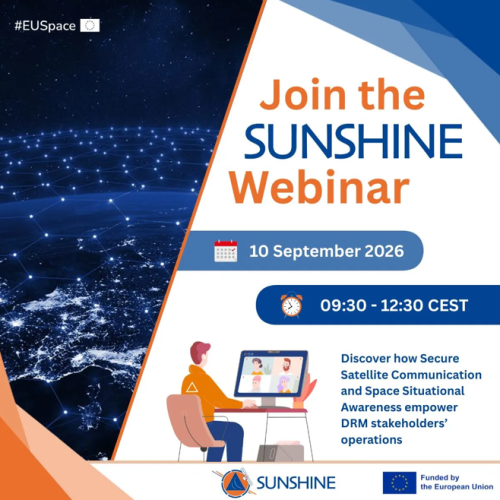
On 10 September 2026, the SUNSHINE projectopens in new tab consortium delivered its final Training Webinar, dedicated to the use of EU Space services for Secure Communications and Space Situational Awareness (SSA). The half-day online session brought the project's webinar programme to a close, after a cycle which guided the European civil protection community through the components of the EU Space Programme and their operational applications in disaster management.
The first session opened with the fundamentals of satellite communication, then turned to the operational situations in which it makes the difference: crisis management with terrestrial networks damaged or overloaded, and work in remote or underserved areas. The focus then moved to GOVSATCOM, which pools national satellite communication capacities under civil and governmental control and connects users to providers through the GOVSATCOM Hub. Trainers presented the actors involved, and walked participants through access management. Each Member State designates a Competent GOVSATCOM Authority (CGA), which manages service activations and provides information on the terminals. The session closed with a status update: the Hub entered into service in January 2026, and Cyprus became the first country to use the service. The second part of the session looked ahead to IRIS², the Infrastructure for Resilience, Interconnectivity and Security by Satellite. Participants were presented with the objectives of the constellation and the deployment timeline leading to services expected towards 2030.
After a short break, the second session shifted to Space Situation Awareness (SSA) and presented its three subcomponents: Space Surveillance and Tracking (SST), Near-Earth Objects (NEO), and Space Weather Events (SWE). Participants saw what each of the subcomponents deliver to national authorities, from collision avoidance and fragmentation analysis to re-entry analysis and space weather alerts, as well as the role of the Galileo Emergency Warning Satellite Service (EWSS) in alerting the population when a re-entry is expected. The most hands-on part of the webinar came with live demonstrations of the operational front desks. Sharing their screens, the trainers showed participants how to register on the EU SST portal, consult the list of upcoming re-entry events and their risk levels, select the countries to monitor as areas of interest, and switch on event notifications. The same exercise followed on the Current Space Weather portal of the ESA Space Weather Service Network.
With this session the SUNSHINE webinar programme comes to an end, but the material remains available to the whole community. Recordings and slides from all the project webinars can be accessed on the SUNSHINE pageopens in new tab of the UCP Knowledge Network, together with the other resources produced by the project.
The capacity-building journey now reaches its final step. On 6-7 October 2026, Brussels will host the second and final SUNSHINE Simulation Exerciseopens in new tab, in which civil protection professionals will face realistic crisis scenarios designed to test the use of EU Space data and services. This is the last opportunity to take part: places are limited and a selection process applies. Express your interest today!opens in new tab
🎥 Missed the webinar?
Watch the full recording here: https://youtu.be/suxP6ukaEpQ?si=ESJXKQQbZ9jh6rOjopens in new tab
Check and download the slides here: https://civil-protection-knowledge-network.europa.eu/media/sunshine-webinar-govsatcom-iris2-ssa-10-september-2026-slides
Thematic series