You are about to be redirected to EU Login, our authentication service.
The UCPKN platform offers different kinds of information views based on the identification of the user, and its associated roles. If it is the first time you are logging in to the platform, your profile will be validated at the end of the process, and you will receive a label and/or associated roles on the platform based on the information provided by you.
If you are a civil protection expert active in the context of the Union Civil Protection Mechanism operations (e.g., training, exercises, deployments), make sure you are using the same email address you used for training/deployment registration for a proper creation of your profile.
Civil protection exercises as strategic tools for preparedness
Published on
The gap between research and practice in disaster risk management is well documented. At the International Conference on Resilient Systems (ICRS 2026), held on 23–24 March at the Technical University of Delft, over 100 researchers from across Europe presented work on resilience, disaster risk management, and emergency response.
By Knowledge Network – Staff member
A key takeaway was that resilience is increasingly seen as a shared challenge across sectors, requiring more joined-up approaches.
A recurring observation was that research outputs are not consistently linked to EU-level policy priorities, including the Union Civil Protection Mechanism (UCPM) and the Preparedness Union Strategy (PUS). Research relevant to civil protection exists, but it is not always effectively translated into practice. The work of Jurgena Kamberaj, Senior Researcher at the Risk and Resilience Team of ETH Zurich's Center for Security Studies (CSS), is a concrete example of how that connection can be strengthened. Her research focuses on the strategic value of civil protection exercises, and broader work on crisis governance. drawing on analysis of the Full-Scale exercise Magnitude, selected for funding under the UCPM Full Scale Exercise programme in 2023, and conducted in Baden Wurttemberg, Germany, in October 2024.
The MAGNITUDE exercise is an international Full-Scale Exercise under the Union Civil Protection Mechanism (UCPM), based on a simulated large-scale earthquake scenario in southwest Germany. It was designed to test cross-border cooperation and coordination between national authorities and international response teams, including partners from neighbouring countries such as Switzerland and Austria.
Last updated: 28 April 2026
“Exercises like MAGNITUDE matter because they make visible where coordination holds, where friction appears, and what this tells us about the system as a whole.”
Jurgena Kamberaj, Senior Researcher at the Risk and Resilience Team of ETH Zurich's Center for Security Studies (CSS)
We should not see exercises only as preparation for response, but also as preparation for leadership, cooperation, and institutional adaptation.
Jurgena Kamberaj
Exercise as a link between research and practice
At ICRS 2026, several contributions explored how research can support operational practice, from stress-testing infrastructure to improving decision-making under uncertainty. Other contributions looked at emerging issues, such as the use of AI in emergency response and the impact of weakening administrative capacity on crisis management.
A related challenge raised repeatedly was how to better involve practitioners in research projects. Where this works well, civil protection authorities are involved from the start.
Kamberaj’s work reflects this same logic. Rather than treating research and operations as separate domains, it looks at exercises as one of the few environments where they come together under realistic conditions.
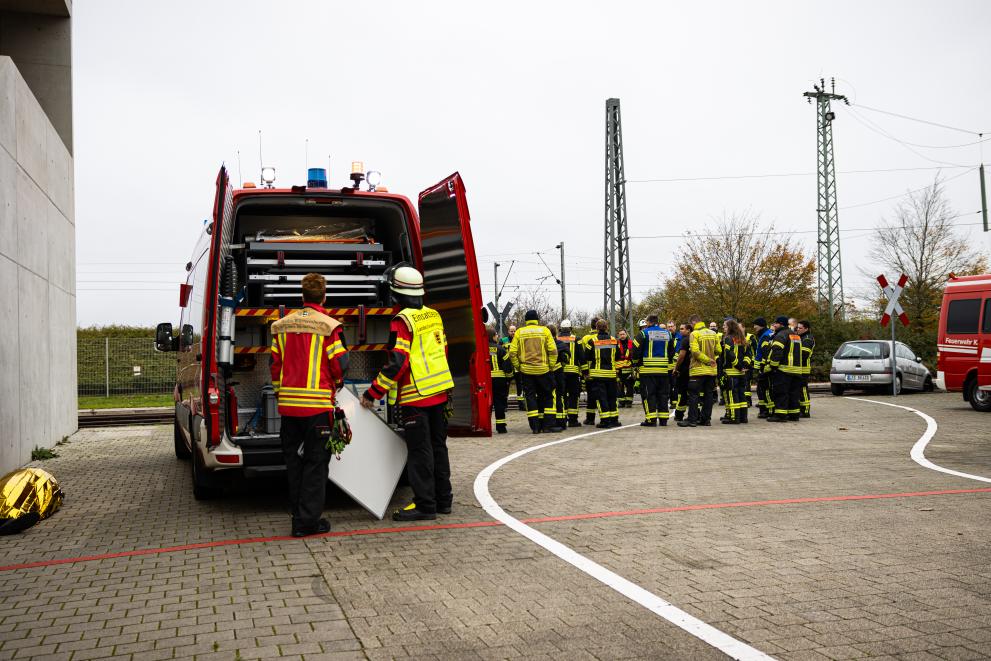
Civil protection teams prepare equipment and coordinate on site during the MAGNITUDE full-scale exercise in southwest Germany. Source: Baden-Württenberg Ministerium des Inneren, für Digitalisierung und Kommunen
Exercises as strategic tools
A central insight from Kamberaj’s work, including the Risk and Resilience Report: The Strategic Value of Civil Protection Exercises, is that exercises generate value beyond their traditional role as training tools. They provide a setting to test how systems are organised, how decisions are made, and how cooperation works in practice.
Preparedness is not only about capabilities, but also about governance, coordination and the ability to adapt to complex situations.
Cross-border cooperation
MAGNITUDE offered useful insight into how cross-border cooperation works in practice under the UCPM. The procedural and technical dimensions of interoperability are well established and remain essential. However, the exercise highlighted another dimension: cooperation depends on relationships.
“Interoperability is not only practical. It is also relational. Trust and familiarity are what make cooperation work in a real event.”
These relational factors are built over time, often through repeated interaction in exercises.
The implication is clear: practising together across national and institutional boundaries is not optional, it is a structural requirement for effective cross-border response.
The implementation gap
A key issue emerging from both ICRS discussions and Kamberaj’s research is what happens after exercises take place. While lessons are identified, they do not always lead to concrete changes.
“Lessons are often identified but not embedded… many of the right lessons remain on paper instead of becoming institutional reform.”
Several factors explain this. Findings often remain confined to technical communities, while responsibilities for follow-up are spread across institutions. In addition, unlike real events, exercises rarely attract sufficient political attention to prompt change.
For exercises to lead to change rather than just learning, the right actors need to be engaged from the outset — including those with the authority to adjust mandates, allocate resources, and shape institutional frameworks.
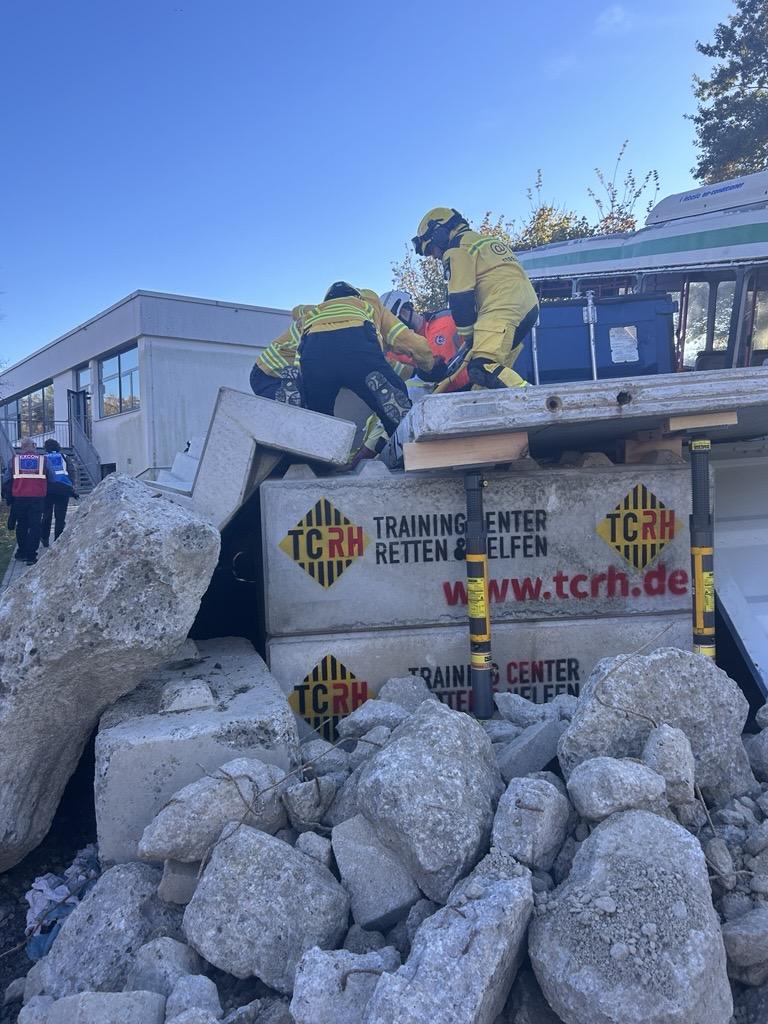
Rescue teams conduct search and extraction operations in a simulated collapsed structure during the MAGNITUDE exercise.
Exercises allow us to see how institutions move between anticipating and acting, and how they adapt as a situation escalates.
Jurgena Kamberaj
Exercises as “laboratories of governance”
Kamberaj describes exercises as “laboratories of governance”. This shifts the focus from individual performance to how systems function as a whole.
“Exercises allow us to see how institutions move between anticipating and acting, and how they adapt as a situation escalates.”
This distinction is important. Emergency management focuses on applying existing plans. Crisis governance requires recognising escalation, managing complexity and maintaining legitimacy while making difficult decisions. Full-scale exercises such as MAGNITUDE create conditions where both can be observed.
Capturing this value requires deliberate choices: broader participation, including at strategic level, evaluation frameworks that go beyond technical performance, and clearer links between exercise outcomes and policy processes.
The discussions at ICRS 2026 pointed to a need to better connect research, policy and practice. Kamberaj’s research shows that civil protection exercises are one of the few spaces where this already happens in practice. Used more deliberately, they can help translate research into operational and governance improvements, ensuring that knowledge informs real-world preparedness.
About the author
The Knowledge Network – Staff member
The Knowledge Network editorial team is here to share the news and stories of the Knowledge Network community. We'd love to hear your news, events and personal stories about your life in civil protection and disaster risk management. If you've got a story to share, please contact us.