You are about to be redirected to EU Login, our authentication service.
The UCPKN platform offers different kinds of information views based on the identification of the user, and its associated roles. If it is the first time you are logging in to the platform, your profile will be validated at the end of the process, and you will receive a label and/or associated roles on the platform based on the information provided by you.
If you are a civil protection expert active in the context of the Union Civil Protection Mechanism operations (e.g., training, exercises, deployments), make sure you are using the same email address you used for training/deployment registration for a proper creation of your profile.
First Diversity and Inclusion Manual for UCPM training
Published on
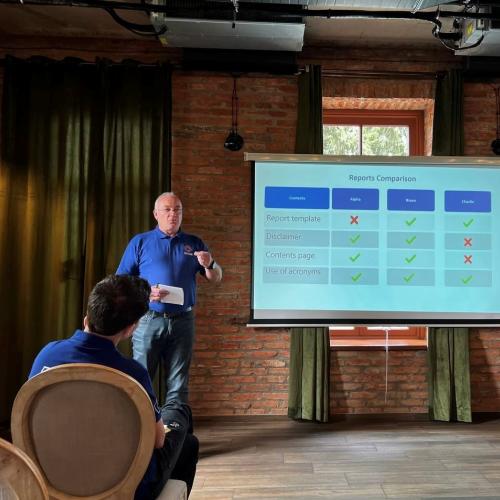
As the Union Civil Protection Mechanism (UCPM) strengthens its approach to Diversity and Inclusion (D&I) in training, the newly developed Diversity and Inclusion Manual for UCPM training and course staff marks a shift from principles to practical application. To explore how this translates into day-to-day course delivery, we spoke with Sean Moore, lead author of the manual.
By Knowledge Network – Staff member
Sean Moore is a resilience and emergency management specialist with over 35 years of experience in civil protection, international deployments, and training. He has deployed to 16 international disasters and has extensive experience across the UCPM, the United Nations (UN), and the International Search and Rescue Advisory Group (INSARAG) frameworks.
He has contributed to more than 40 EU MODEX exercises and over 70 UCPM training courses, working as trainer, evaluator and exercise lead. His work spans a range of operational contexts, including CBRN, floods, wildfires and USAR, and includes the development of key training and evaluation guidance, including the Diversity and Inclusion Manual.
How does the Manual complement the existing D&I Handbook?
The Handbook and the Manual were designed to work together. The Handbook defines what D&I means in the UCPM context, why it matters operationally, and how it is integrated across the UCPM deployable training pathway. The Manual then translates that framework into daily practice for course trainers and staff. In simple terms, the Handbook provides the “why, what, and where”, while the Manual provides the “how, when, and what to do”. It gives training staff practical guidance on modelling inclusive behaviours, managing group dynamics, intervening proportionately, recording any issues factually, and protecting psychological safety during the different course deliveries.
What were the main challenges in developing D&I practical guidance for UCPM Deployable Training?
One of the main challenges was turning broad D&I principles into guidance that is written in a practical way to actually help training staff. UCPM training is multinational, multilingual, operationally focused, so the guidance had to be realistic, and usable across very different course types and delivery formats. Another challenge was avoiding a purely theoretical or compliance driven document. We wanted something that training staff could use in difficult moments: when managing dominance, supporting quieter participants, addressing inappropriate language, handling disagreements, or deciding when to intervene and when to escalate.
Inclusive practice is visible in the everyday choices training staff make before, during, and after a training session.
Sean Moore
What does inclusive practice look like during a training course?
Inclusive practice is visible in the everyday choices training staff make before, during, and after a training session. It means setting a respectful tone from the start, establishing clear ground rules, communicating in plain and inclusive language, creating multiple ways for people to contribute, and making sure psychological safety is understood and protected. It also means being alert to group dynamics: who is dominating, who is withdrawing, who may be constrained by language, confidence, hierarchy, culture, or gender dynamics. Inclusive practice for trainers involves being fair and consistent and intervening proportionately when behaviour undermines inclusion, although thankfully this happens infrequently.
What are the most common challenges trainers face when applying D&I?
The most common challenges are usually recurring behaviours that can gradually undermine inclusion if left unaddressed. These include dominant participants taking too much airtime, quieter or less confident participants withdrawing, interruptions, dismissive language, inappropriate humour, hierarchy effects, culturally narrow assumptions, and defensiveness when challenged. Trainers also have to manage more difficult situations such as discriminatory remarks, exclusionary behaviour, resistance to feedback, or conduct that crosses professional boundaries. What makes these issues challenging is that trainers have to respond in a calm, fair, and proportionate way and that protects the wider learning environment.
The most important message is that D&I is not an optional extra or a separate topic; it is part of professional UCPM course delivery.
Sean Moore
What does success look like for this Manual one year from now? How would you measure its impact?
Success would mean that the Manual is being used in practice, not just read once and filed away. One year from now, I would hope to see more consistent trainer and course staff D&I positive practice across courses, earlier and more confident interventions when inclusion is at risk, and stronger alignment between D&I expectations and what participants actually experience during the training. The Manual itself is described as a living resource, so another sign of success would be that it is being refined over time based on experience from training delivery.
From your perspective as lead author, what is the most important message you would like training staff to take away from this Manual?
The most important message is that D&I is not an optional extra or a separate topic; it is part of professional UCPM course delivery.Training staff shape the learning environment every day through how they facilitate, communicate, observe, respond, and model behaviour. High performance does not happen by accident; it is most likely when participants feel psychologically safe, treated fairly, and able to contribute fully.
We need to move away from seeing D&I as a standalone theme and towards treating it as a professional competence.
Sean Moore
Looking ahead, how do you see D&I evolving within UCPM training?
I think D&I will become increasingly embedded as a normal part of how UCPM training is designed, delivered, assessed and evaluated. We need to move away from seeing D&I as a standalone theme and towards treating it as a professional competence.The Consortium in charge of implementing the UCPM Deployable training (Three Vertices – TVC), has invested significantly to ensure that D&I is integrated into course design, briefings, observation practice, feedback and participant performance assessment and evaluation, and I hope that, over time, this will be reflected in more consistent practice, stronger learning environments, and better overall training outcomes.
2 Likes
About the author
The Knowledge Network – Staff member
The Knowledge Network editorial team is here to share the news and stories of the Knowledge Network community. We'd love to hear your news, events and personal stories about your life in civil protection and disaster risk management. If you've got a story to share, please contact us.