You are about to be redirected to EU Login, our authentication service.
The UCPKN platform offers different kinds of information views based on the identification of the user, and its associated roles. If it is the first time you are logging in to the platform, your profile will be validated at the end of the process, and you will receive a label and/or associated roles on the platform based on the information provided by you.
If you are a civil protection expert active in the context of the Union Civil Protection Mechanism operations (e.g., training, exercises, deployments), make sure you are using the same email address you used for training/deployment registration for a proper creation of your profile.
From rapid assessment to community care: PHF in Mayotte
Published on
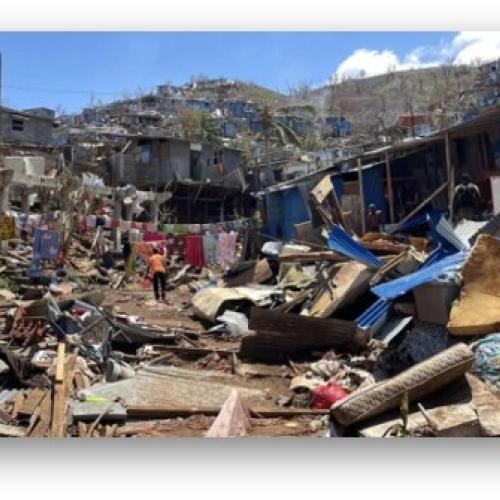
When Cyclone Chido struck Mayotte on 14 December 2024, it left the French region facing one of its most severe natural disasters in decades. With wind gusts exceeding 200 km/h, the cyclone caused extensive damage to infrastructure, and disrupted access to essential services.
By Knowledge Network – Staff member
Official figures reported 39 fatalities, more than 4,200 injured, and over 19,000 buildings damaged or destroyed, alongside 105 km of roads rendered unusable. For a region already facing structural vulnerabilities, the scale of the impact demanded an immediate and well-coordinated response.
The scale of destruction required an exceptional mobilisation of French civil protection resources. According to Lieutenant-Colonel Frédéric Harrault, on-site officer in charge of operations, the event led to one of the largest civil protection responses organised by France in modern history. Resources were pre-positioned before the cyclone made landfall, with military civil protection brigades and firefighters from Réunion deployed in advance. In the days that followed, France launched its largest airlift operation to support Mayotte, allowing the rapid arrival of responders, equipment and humanitarian aid. The activation of the EU Civil Protection Mechanism further strengthened the response, with material support from Belgium, Germany, Italy, Luxembourg and Sweden.
Last updated: 18 March 2026
Within this large-scale response, firefighter NGOs provided flexible, community-based support alongside institutional emergency services. Pompiers Humanitaires Français (PHF), working with other firefighter NGOs coordinated by the Fédération Nationale des sapeurs-pompiers de France, deployed rapid-response missions to support the population during the local emergency.
Early assessment and integration into the response
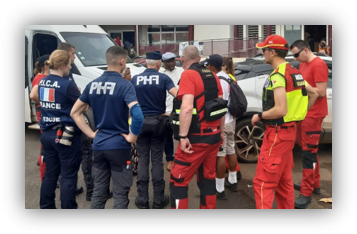
PHF’s engagement began with an early assessment mission deployed in the days following the cyclone, enabling rapid coordination with the Centre Opérationnel Départemental, the Mayotte Departmental Fire and Rescue Service and local authorities.
“Our very early arrival allowed us to establish contact quickly with the authorities and position NGO action where it was most useful,” explains Jérôme Giron, President of PHF. Early coordination with the Centre Opérationnel Départemental, the Mayotte Departmental Fire and Rescue Service and local authorities, helped ensure that humanitarian efforts complemented, rather than duplicated, institutional response.
The work carried out over several years to allow multiple firefighter NGOs to operate together under a shared charter of values clearly facilitated coordination.
Jérôme Giron, President of PHF
Years of preparatory work between firefighter NGOs also proved decisive. Shared operational standards and a common command structure enabled multiple organisations to work together efficiently, pooling skills, equipment and logistics. While no direct support from European civil protection mechanisms was activated, the response demonstrated how structured NGO coordination can reinforce national capacities, particularly in geographically isolated territories such as Mayotte.
Delivering healthcare close to affected communities
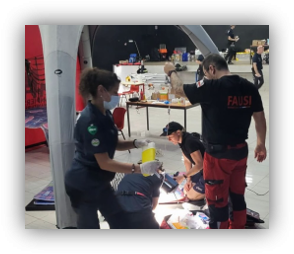
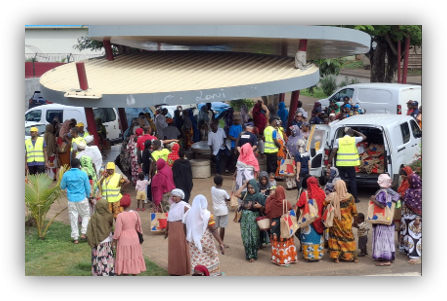
Medical care quickly became a central pillar of the response. PHF teams deployed fixed and mobile dispensaries, designed to reach populations whose access to healthcare had been severely disrupted by the cyclone.
Houyame Nassih, a paediatric intensive care nurse and volunteer firefighter nurse who joined the second PHF team from 26 December 2024 to 8 January 2025, describes a medical landscape shaped by both disaster-related injuries and the collapse of routine care. Patients presented with untreated wounds, infected injuries caused by debris, severe dehydration, particularly among infants due to water shortages, and interruptions in chronic disease management.
To reach the most vulnerable, teams conducted maraudes (outreach patrols) in isolated Bangas (informal or semi-permanent dwellings commonly found in Mayotte, often built from lightweight or salvaged materials), where access was often difficult due to debris and heat.
One encounter particularly marked her: “During a maraude in an isolated Banga, we treated a very young infant showing signs of severe dehydration. The family was living in extremely precarious conditions, with difficult access and intense heat. It really illustrated the extreme fragility of populations after a natural disaster—and the importance of going to those who cannot come to you” shares Nassih.
The most vulnerable were often infants, children, pregnant women, and injured men who simply could not move.
Houyame Nassih, intensive care nurse and volunteer firefighter
Stefan von Croy, a PHF volunteer deployed during a later phase of the response, highlights that this proximity-based approach was essential to reaching people who were unable or reluctant to access formal health services. Mobile and community-based care helped ensure that vulnerable populations were not left outside the response system.
Operational support and logistical autonomy
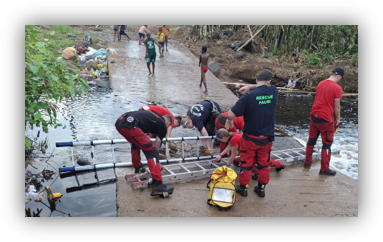
Alongside healthcare delivery, PHF volunteers carried out reconnaissance missions, route clearance and safety operations, particularly in Dembeni and the north-west of the island. These activities included clearing fallen trees, securing damaged buildings and restoring access to isolated areas.
Christophe Petit, a volunteer firefighter deployed as part of the third mission, explains that “our missions mainly consisted of reconnaissance and multiple interventions in Dembeni and in the north-west of the island,” he says. “We provided care through a fixed dispensary and a mobile dispensary, but also carried out technical missions such as tree cutting and securing damaged buildings.”
A key enabling factor was the teams’ complete logistical autonomy: “Our team was composed of 12 responders and was equipped to operate in full autonomy for 15 days,” Petit explains. “Food, water potabilisation (making it safe for human consumption) and logistics were all anticipated, which allowed us to maintain continuity despite sometimes degraded conditions.”
As the weeks passed, the nature of needs on the ground began to shift. Initial priorities focused on life-saving care, access to potable water and the distribution of basic necessities. Gradually, as immediate risks were stabilised, medical consultations increasingly moved towards preventive care and follow-up, reflecting a transition from acute emergency to early recovery.
Arriving after the immediate shock phase, von Croy observed a situation that remained extremely fragile but where early signs of stabilisation were beginning to appear. “It was not really an improvement yet,” he explains, “but you could already see buildings that had been temporarily stabilised, and the sense that life was starting to continue, little by little.”
Across the successive missions, PHF and partner NGOs activated 12 dispensaries, delivered more than 600 medical consultations and 900 individual treatments, distributed 2,610 food parcels, and supported 400 people with access to drinking water. Technical teams also completed 17 access-clearing worksites and multiple safety operations.
Human engagement and resilience
Beyond the operational figures, volunteers consistently emphasised the resilience, dignity and solidarity of the Mahoran population
For PHF leadership, the mission also demonstrated the added value of firefighter NGOs within complex emergency environments. “The coordination between NGOs made it possible to deliver a real humanitarian response alongside institutional emergency services,” Giron concludes. “This complementarity is essential when facing disasters of this magnitude.”
As the phase of extreme emergency draws to a close, PHF is exploring longer-term actions in health and hygiene, in coordination with national partners.
What struck me most was the resilience of the people. Our work is not only about technical care—it is also about presence, listening and human support.
Houyame Nassih
Lessons for future preparedness
Reflecting on Cyclone Chido, Jérôme Giron highlights the structural challenges linked to Mayotte’s geographical isolation, particularly the dependence on air and sea bridges for reinforcements and supplies. He points to the potential value of pre-positioning specialised resources ahead of forecast cyclones and strengthening reception and coordination capacities at entry points.
About the author
The Knowledge Network – Staff member
The Knowledge Network editorial team is here to share the news and stories of the Knowledge Network community. We'd love to hear your news, events and personal stories about your life in civil protection and disaster risk management. If you've got a story to share, please contact us.