
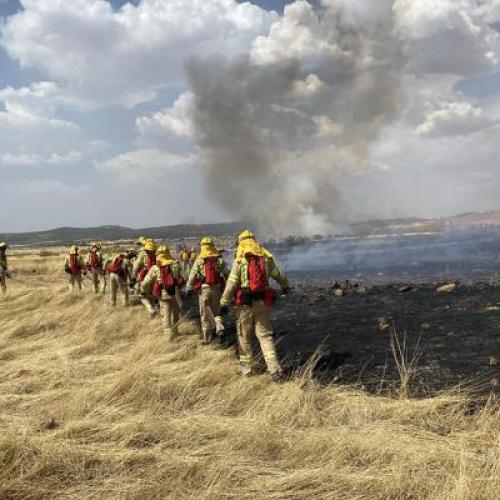
One key instrument that we want to promote is pre-commercial procurement, which allows end users to move from the pilot phase to the solution that can be used universally.
After a record wildfire year, addressing the increasing wildfire risk due to climate change, with the rapid development and subsequent operational uptake of innovative assets, equipment and tools will be key to prepare the Union for upcoming wildfire seasons.
To address this challenge, the Commission held an Innovation uptake on wildfire preparedness workshop on 12 March to present several innovative technologies that have been developed through Horizon Europe, as well as explore avenues to upscale them using Commission innovation procurement tools. The workshop took place under the Community of European Research and Innovation for Security (CERIS) in view of the upcoming Horizon Europe work programme 2026-2027, where multiple topics for innovation procurement will be open for application.
As part of the upcoming Integrated Wildfire Risk Management Communication, accelerating innovation procurement of wildfire preparedness technologies is one important element. The aim of the workshop was to facilitate stronger involvement of civil protection end-users in the technology development phase and to match existing projects with competent authorities from the Union Civil Protection Mechanism (UCPM). The EU-funded pre-commercial procurement (PCP) process was introduced to the 100 participants both in-person and online.
It was opened by Directors Corinna Ullrich and Hanna Jahns from DG HOME and DG ECHO respectively stressing, for example, the need for seamless operationalisation of research results to the end user and strategic autonomy of European aerial firefighting. During the interactive workshop, participants built future use cases, for example, on interoperable cross-border early warning systems for wildfire and joint development of new personal protective gear for firefighters. You can find recordings of the sessions here.
Below are two examples of forthcoming opportunities on innovation procurement that can support wildfire preparedness.

© French Civil Protection, 2025. All rights reserved.
Horizon Europe call for proposals on pre-commercial procurement opening in May 2026
For example, a Demand-led innovation in security call with approximately EUR 5.8 million for pre-commercial procurement (PCP) of innovative technology solutions with common user/functional needs will open in Horizon Europe on 15 May 2026 and close on 5 November 2026.
As past experience shows that PCP opens up the procurement market for startups and enables the public sector to address societal challenges more effectively, public procurers should make more strategic use of PCP. Applicants are invited to submit proposals for PCP action to acquire research & development services and innovative civil security technology solutions.
Proposals should demonstrate interest from a broader community of potential buyers, beyond the direct beneficiaries, who share similar needs and are open to jointly adopting the solutions developed, provided they are proven mature and operationally viable. The proposals are expected to include an analysis of the state of the art and market landscape, aligning research activities with identified needs and presenting a range of technical alternatives to address the challenge.
ACTIVE project on personal protective equipment, seeking stakeholders
The recently started ACTIVE PCP project aims to address critical gaps in personal protective equipment (PPE) for first responders facing increasingly complex threats, whether man-made or natural. It seeks to leverage innovative procurement methods to stimulate research and development in the private sector, encouraging the creation of cutting-edge PPE solutions tailored to the unique challenges of modern emergency response.
The project is now looking for stakeholders to join its boards, such as a firefighting organisation seeking to modernise its equipment, and will hold open market consultations as follows:
- Greece & Cyprus, 27 April 2026, online (in Greek)
- Austria & Germany, 28 April 2026, online (in German)
- Lithuania, 29 April 2026, online (in Lithuanian)
- Spain, 30 April 2026, online (in Spanish)
- Belgium, 7 May 2026, Permanent Representation of Greece to the EU (in English)
Register for the open market consultations here.
Related news
Sectors
Risk drivers